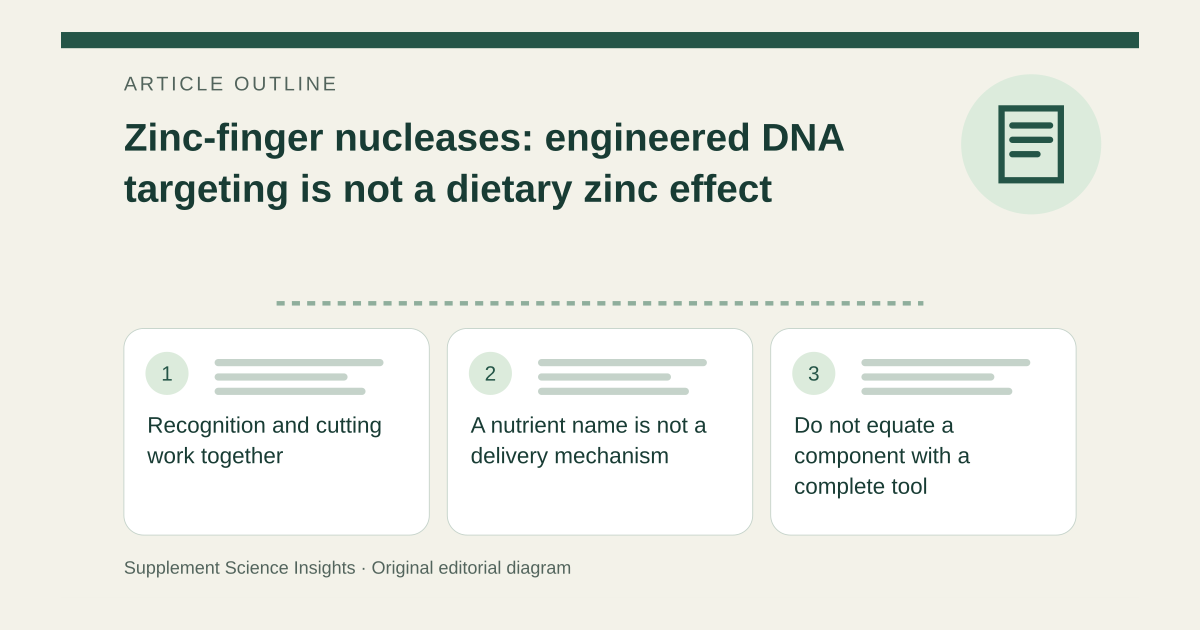
Recognition and cutting work together
The National Human Genome Research Institute describes zinc-finger nucleases as engineered from naturally occurring proteins. Their DNA-recognition component is designed for a target sequence, allowing the associated cutting activity to act at that location. [1]
The resulting break can be used in an editing process, including replacement through a repair pathway. Changing the target generally requires engineering a different recognition protein. [1]
A nutrient name is not a delivery mechanism
The tool requires a deliberately designed molecular system and a way to reach the relevant cells. Dietary zinc does not supply that sequence-specific design or the rest of the editing procedure. [1]
The cited source explains genome-editing technology rather than a clinical supplement experiment. It does not establish an individual treatment, guarantee error-free editing or imply that ordinary zinc-containing foods alter DNA in the targeted way a laboratory nuclease is intended to do. [1]
Do not equate a component with a complete tool
Imagine an engineered protein needs a particular structural component. Supplying that component as a nutrient is not the same as supplying the entire correctly designed protein to the correct cell.
| Detail | Interpretation |
|---|---|
| DNA recognition | Target-specific protein design |
| Nuclease activity | Cuts DNA |
| Oral zinc | Not the editing system |
Sources for this article
- How Does Genome Editing Work?
Source consulted: 2026-09-19. This is a reference resource, not a claim that we conducted the studies or tested a product.