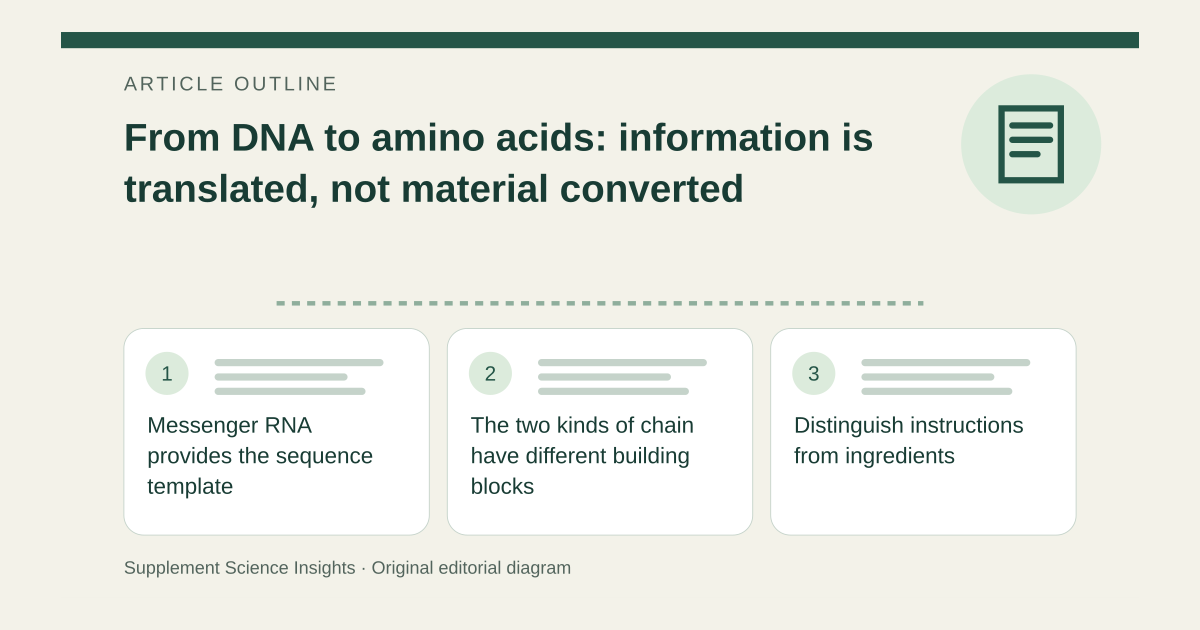
Messenger RNA provides the sequence template
For a protein-coding gene, transcription first makes an RNA copy of the DNA instructions. Messenger RNA carries that information to the protein-synthesis machinery, where translation determines the amino-acid order. DNA supplies the encoded instructions; amino acids supply the protein’s building blocks. [1][2]
Protein synthesis uses an mRNA template, ribosomes, transfer RNAs and enzymes. The ribosome reads the mRNA in codons, groups of three nucleotides. Most codons specify an amino acid, while stop codons signal termination. [1][2]
Transfer RNAs act as adapters: they carry amino acids and pair with codons through their anticodons. Enzymes help attach the appropriate amino acid to its transfer RNA. The process connects a nucleotide-based message to an amino-acid chain. [1][2]
The two kinds of chain have different building blocks
Nucleic acids use nucleotides, while proteins use amino-acid residues. Translation transfers information between those systems; it does not change a DNA molecule into a string of amino acids. [1]
Amino-acid availability is necessary for synthesis, but it does not independently select the encoded order. A supplement containing a particular amino acid therefore does not direct the cell to place it at any desired position in a protein. Sequence, regulation and material supply are distinct aspects of the process. [1]
Distinguish instructions from ingredients
Imagine a fictional mRNA contains several codons recognized by matching transfer RNAs. The codon order determines the order of additions. Providing more of one ingredient does not rewrite the order of the message.
| Description | Interpretation |
|---|---|
| mRNA codon sequence | Information template |
| Transfer RNA | Adapter carrying an amino acid |
| Growing polypeptide | Different molecular product |
Sources for this article
- OpenStax Biology 2e: Ribosomes and Protein Synthesis
Source consulted: 2026-09-17. This is a reference resource, not a claim that we conducted the studies or tested a product. - NHGRI — Transcription
Source consulted: 2026-09-20. This is a reference resource, not a claim that we conducted the studies or tested a product.