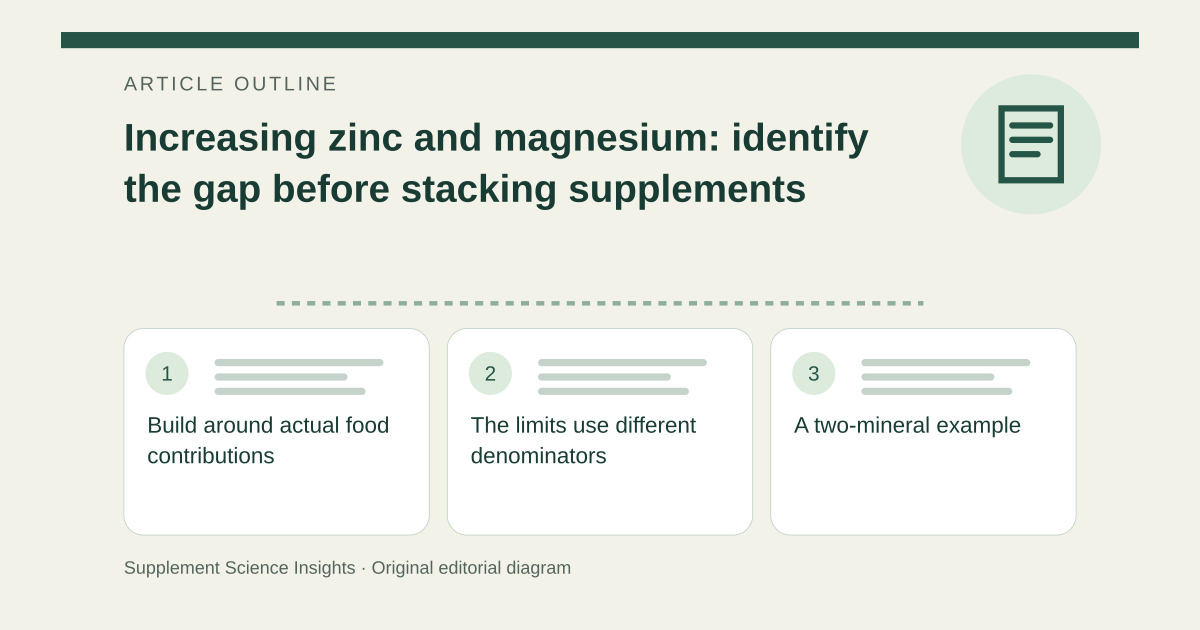
Build around actual food contributions
Zinc sources include meat, seafood, dairy, beans, nuts and whole grains. Magnesium sources include nuts, seeds, legumes, leafy vegetables and whole grains. A varied food pattern can contribute to both, but the amount in a serving matters. Adding a mineral name to a meal description does not quantify its intake. [1][2]
The limits use different denominators
For adults, the general zinc upper limit is 40 mg from all sources. Magnesium’s 350 mg upper limit applies to supplements and medicines, excluding naturally occurring food magnesium. Confusing these rules can lead either to unnecessary food restrictions or to overlooking supplemental excess. Neither upper limit is an intake target. [1][2]
A two-mineral example
Imagine a proposed combined product supplies 15 mg zinc and 100 mg elemental magnesium. Record those amounts separately and add other products rather than treating the combination as a single dose. A food review can help identify a likely gap, while kidney disease, malabsorption or symptoms may require clinical assessment. More of both is not automatically better. [1][2]
| Hypothetical product contribution | How to assess it |
|---|---|
| Zinc 15 mg | Add food and all other zinc sources |
| Magnesium 100 mg | Include other supplements and medicines forUL comparison |
| A nutritional gap | Check dietary changes and clinical context |
Sources for this article
- Zinc - Health Professional Fact Sheet
Source consulted: 2026-09-20. This is a reference resource, not a claim that we conducted the studies or tested a product. - Magnesium - Health Professional Fact Sheet
Source consulted: 2026-09-20. This is a reference resource, not a claim that we conducted the studies or tested a product.