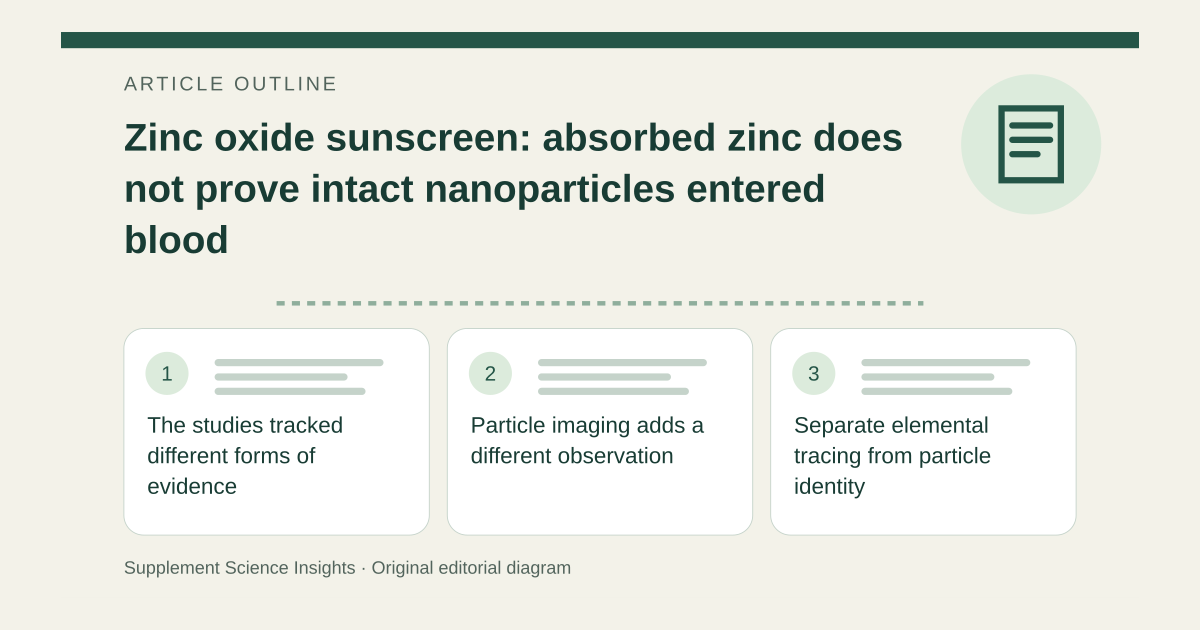
The studies tracked different forms of evidence
A 20-person outdoor study detected small increases in isotope-labeled zinc in blood and urine after sunscreen use. Most applied zinc was not absorbed, and the study could not determine whether the detected zinc had entered as intact particles, soluble zinc or both. [1]
Particle imaging adds a different observation
A later repeated-application study found zinc oxide particles on the surface and in skin furrows, without entry into the viable epidermis or observed local cellular toxicity. Small zinc-ion changes were detected in excised skin. [2][1][3]
The earlier paper’s correction clarified wording about particle localization in the outer skin layer. These short studies do not establish every formulation, skin condition or exposure route. Funding and conflicts were not fully assessed from the abstracts. Neither a blanket zero-absorption statement nor a claim that intact nanoparticles necessarily entered blood follows from combining the findings. [2][1][3]
Separate elemental tracing from particle identity
Imagine a tracer identifies zinc from a product in a sample. An additional method is needed to establish the chemical form in which it traveled.
| Detail | Interpretation |
|---|---|
| Isotope tracing | Identifies product-derived zinc |
| Particle imaging | Assesses intact-particle location |
| Dissolved ions | Not equivalent to intact particles |
Sources for this article
- Small amounts of zinc from zinc oxide particles in sunscreens applied outdoors are absorbed through human skin - PubMed
Source consulted: 2026-09-19. This is a reference resource, not a claim that we conducted the studies or tested a product. - Support for the Safe Use of Zinc Oxide Nanoparticle Sunscreens: Lack of Skin Penetration or Cellular Toxicity after Repeated Application in Volunteers - PubMed
Source consulted: 2026-09-19. This is a reference resource, not a claim that we conducted the studies or tested a product. - kfr002 530..530
Source consulted: 2026-09-19. This is a reference resource, not a claim that we conducted the studies or tested a product.