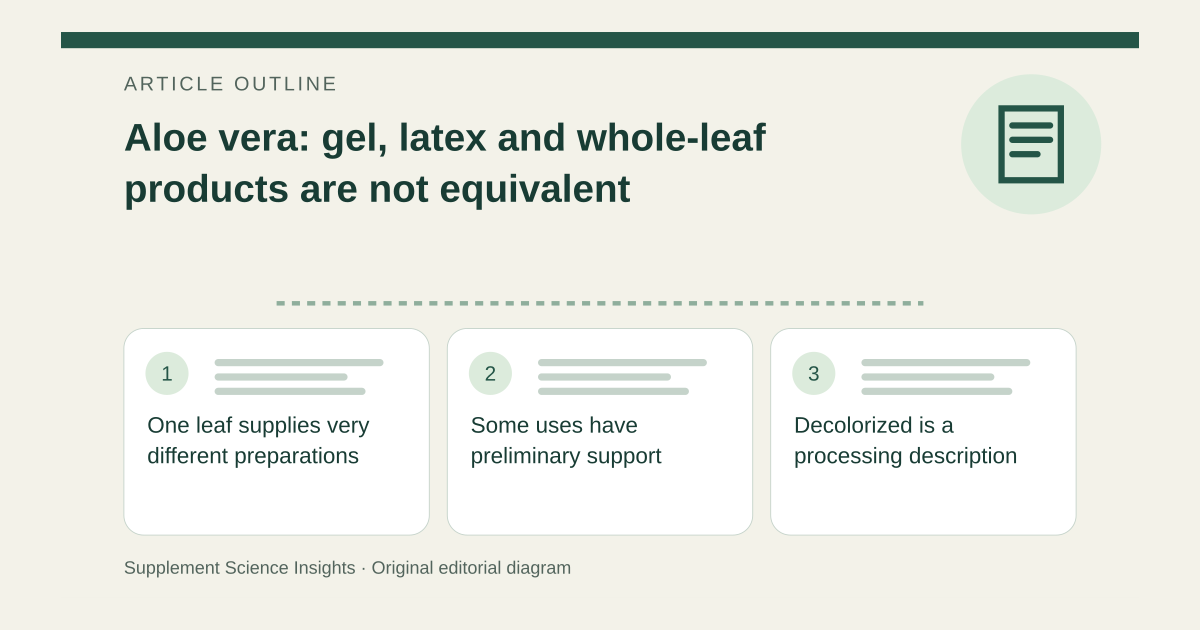
One leaf supplies very different preparations
Aloe products can contain inner-leaf gel, latex from beneath the outer leaf layer, or whole-leaf extract. They may be applied to skin or taken orally. Those distinctions are essential: evidence about a topical gel cannot establish the safety or benefit of a swallowed whole-leaf preparation. [1]
A clear label should identify the plant part, processing and intended route. The word “aloe” alone leaves too much unresolved to transfer findings from a clinical study. [1]
Some uses have preliminary support
NCCIH describes research suggesting topical aloe gel may help some burns and certain skin conditions, but the evidence varies by use. Small oral studies have investigated blood-glucose or body-composition outcomes. These findings do not establish an all-purpose digestive or weight-loss treatment. [1]
The study's co-treatments matter. If aloe was added to another treatment, an outcome cannot be described as proof that aloe alone would do the same thing. Route, preparation and diagnosis must remain attached to the result. [1]
Decolorized is a processing description
Whole-leaf preparations may undergo processing to reduce anthraquinone components such as aloin. A processing claim is useful information, but it is not a complete chemical analysis or a clinical safety guarantee. [1]
For a product comparison, retain the actual wording rather than treating “purified,” “inner leaf” and “whole leaf” as synonyms. If an assay or certificate is cited, identify the tested material and batch before assuming it applies to a bottle on a shelf. [1]
Oral latex has particular concerns
Aloe latex taken orally can cause cramps, abdominal pain and diarrhea. Reports of liver injury have involved oral leaf extracts. Non-decolorized whole-leaf extracts have raised cancer concerns in animal research; that finding should not be mislabeled as a proven effect of every topical aloe gel. [1]
Oral aloe may be unsafe during pregnancy or breastfeeding. Medicines, including digoxin in the context of latex overuse, can introduce additional concerns. Do not use a skin-care product as an oral preparation. [1]
Match the route before comparing quantities
Imagine one bottle lists 30 mL of an inner-leaf drink and another lists 30 mL of a topical gel. Their equal volumes do not establish equal aloe composition or an interchangeable use. A third label stating only “aloe extract” leaves the plant part unresolved.
The comparison table should therefore begin with route and preparation, not a price-per-milliliter calculation. These fictional entries illustrate missing information and do not recommend drinking either product.
| Label | Key distinction |
|---|---|
| Inner-leaf drink | Oral product; full composition needed |
| Topical gel | Not an oral substitute |
| Unspecified extract | Plant part unresolved |
The exact preparation is the subject
Ask about the precise aloe preparation and intended problem. A plant name shared across cosmetics, drinks and laxative history does not make their evidence transferable. Persistent symptoms require an appropriate assessment rather than escalating an unspecified extract.
Sources for this article
- NCCIH — Aloe vera: Usefulness and Safety
Source consulted: 2026-09-17. This is a reference resource, not a claim that we conducted the studies or tested a product.