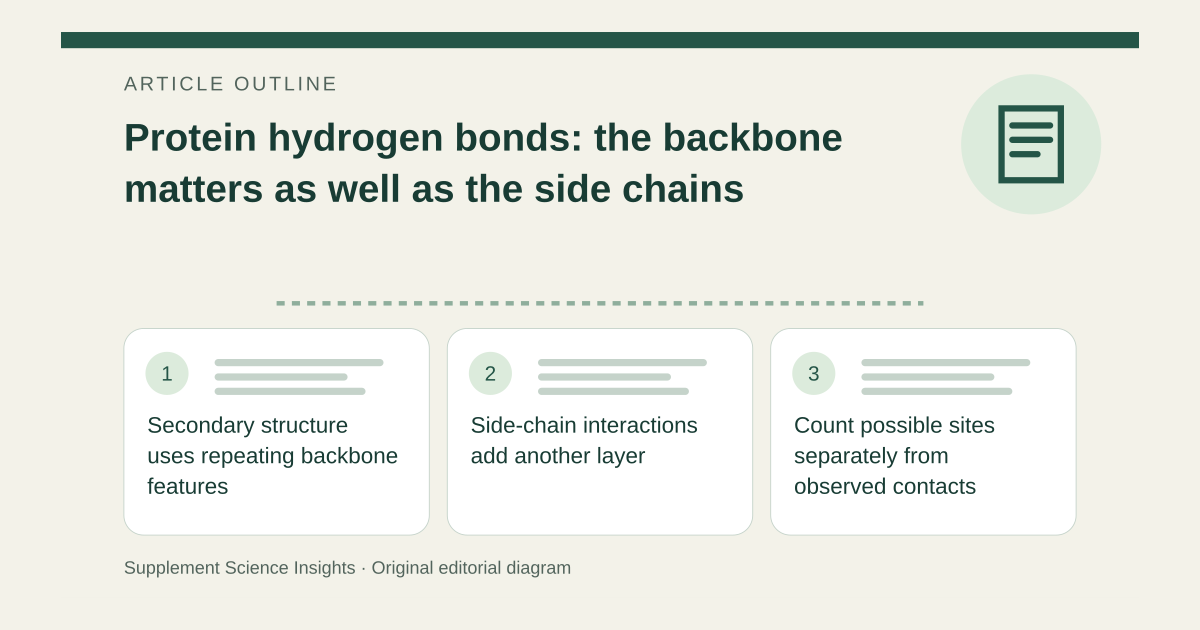
Secondary structure uses repeating backbone features
In alpha helices and beta sheets, hydrogen bonds commonly involve carbonyl oxygen and nitrogen-bound hydrogen in the peptide backbone. These repeating groups are distinct from the variable side chains that distinguish amino acids. [1][2]
Consequently, asking only which side chains are polar leaves out a major source of protein hydrogen bonding. A residue with a nonpolar side chain can still occupy a chain whose backbone participates in these interactions. [1][2]
Side-chain interactions add another layer
Examples include the polar side chains of glutamine, histidine and arginine, which can participate in hydrogen bonding with water or other suitable groups. This is not an exhaustive list or a claim that all three have identical donor/acceptor behavior. Backbone participation remains a separate issue: a nonpolar side chain does not remove the peptide chain’s carbonyl oxygen and nitrogen-bound hydrogen sites. [1][2]
Some side chains contain groups that can donate or accept hydrogen bonds. Whether a particular bond forms depends on chemical state, geometry and the surrounding environment. A potential donor or acceptor is not proof that it forms a specific bond in every protein. [1][2]
One noncovalent interaction is generally weaker than a backbone covalent bond, but many interactions can act together. The stability of a folded structure reflects the network rather than one isolated bond. These structural facts are not evidence that an amino-acid supplement strengthens every protein in the body. [1][2]
Count possible sites separately from observed contacts
Imagine a sequence contains several polar groups. That identifies possible interaction sites. A structural measurement would still be needed to establish which groups actually contact one another in the folded protein.
| Description | Interpretation |
|---|---|
| Potential donor or acceptor | Chemical capability |
| Observed hydrogen bond | Specific structural interaction |
| Fold stability | Combined effect of many interactions |
Sources for this article
- Molecular Biology of the Cell, 4th edition: The Shape and Structure of Proteins
Source consulted: 2026-09-17. This is a reference resource, not a claim that we conducted the studies or tested a product. - OpenStax Biology 2e: Proteins
Source consulted: 2026-09-17. This is a reference resource, not a claim that we conducted the studies or tested a product.