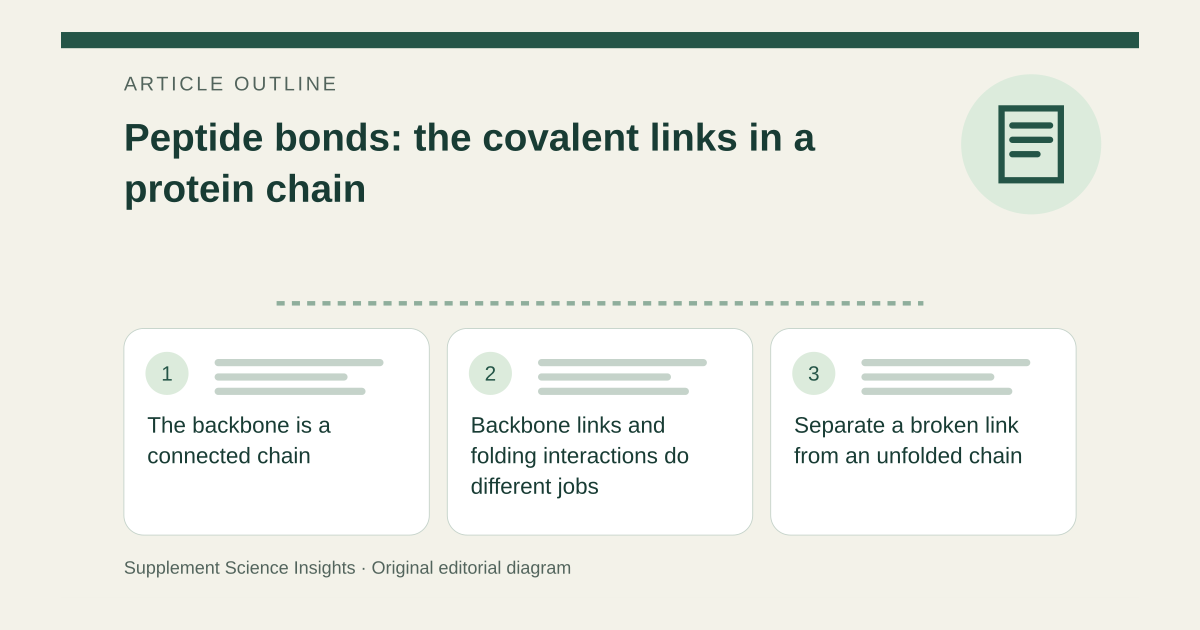
The backbone is a connected chain
The peptide bond is a covalent carbon–nitrogen linkage. In a simplified formation diagram, the carboxyl group of one amino acid and amino group of another join with the net removal of water. Cellular protein synthesis is an enzyme-directed process, not simply mixing free amino acids in a glass. [1]
Repeated links create a polypeptide with an amino end, or N-terminus, and a carboxyl end, or C-terminus. The sequence records the order of residues along that chain. Reversing the written order generally describes a different sequence. [1]
Backbone links and folding interactions do different jobs
Hydrogen bonds, charge interactions and other contacts can help organize the chain into a three-dimensional shape. They should not be confused with the peptide bonds that connect successive residues. A protein can lose its usual fold without every backbone bond being broken. [1]
Hydrolysis breaks peptide linkages using water in the reaction. Thus a hydrolyzed preparation and a merely unfolded protein are not equivalent descriptions. The terms describe different changes and do not independently establish a clinical benefit. [1]
Separate a broken link from an unfolded chain
Imagine a connected necklace is laid out straight rather than coiled. Its arrangement changes while its links remain intact. Cutting links is a different operation. This analogy distinguishes unfolding from chain cleavage without representing the full chemistry.
| Feature | Interpretation |
|---|---|
| Peptide bond | Covalent chain link |
| Folded arrangement | Spatial organization |
| Hydrolysis | Cleavage of a linkage |
Sources for this article
- OpenStax Biology 2e: Proteins
Source consulted: 2026-09-17. This is a reference resource, not a claim that we conducted the studies or tested a product.