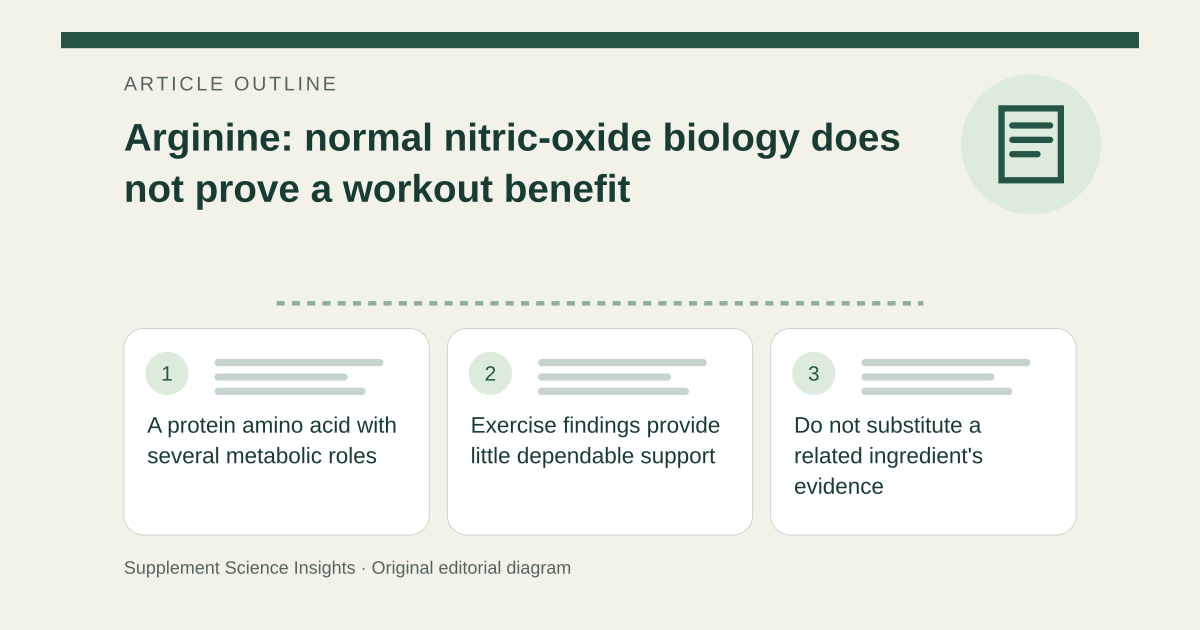
A protein amino acid with several metabolic roles
L-arginine occurs in protein-containing foods and is also synthesized in the body. It participates in nitric-oxide and creatine-related pathways, which helps explain its use in performance marketing. [1]
Those pathways do not establish that taking extra arginine improves the outcome. A precursor can be necessary for a process without being the limiting factor in a healthy person. The supplement question requires a comparison showing what changes when additional arginine is taken. [1]
Exercise findings provide little dependable support
NIH ODS summarizes limited and conflicting research, with little overall support for improved strength, endurance or recovery from supplemental arginine. Many studies were small, short and concentrated in young men. [1]
Changes in growth-hormone measurements have also been inconsistent. Even a temporary increase would not by itself establish muscle growth or improved performance. A hormonal measurement and a training outcome are different endpoints that require separate reporting. [1]
Do not substitute a related ingredient's evidence
Arginine is involved in pathways that also involve citrulline or creatine, but that relationship does not make their supplements interchangeable. Evidence for taking creatine directly is not evidence that an arginine capsule produces the same effect.
Similarly, a blend containing several nitric-oxide-related ingredients cannot identify arginine's independent contribution without an appropriate comparison. The exact formula and background training matter. A feeling of muscle fullness during a session is also not a validated measure of later strength or muscle gain.
Digestive effects and blood pressure require context
Higher supplemental amounts can cause nausea, diarrhea or other gastrointestinal discomfort. Blood pressure can also decrease. Short-term tolerability findings in healthy participants do not establish safety during prolonged use or alongside medicines affecting circulation. [1]
A medical condition or medication list changes the assessment from a simple sports-product comparison. Review the full preparation with a clinician or pharmacist. This page does not provide a regimen for manipulating blood pressure, hormone levels or exercise blood flow. [1]
A hormone snapshot cannot establish muscle growth
Imagine a fictional study records a hormone concentration before and after one serving but does not measure muscle size or strength over time. Its result concerns the laboratory measurement at those timepoints.
A statement that the supplement builds muscle would add an untested conclusion. To evaluate that claim, a study would need an appropriate training period, comparison and direct measurement of muscle or functional change.
| Hypothetical measurement | What it cannot establish |
|---|---|
| Hormone level after one serving | Long-term muscle growth |
| Muscle fullness | Sustained strength gain |
| Related biochemical pathway | Equivalent supplement effect |
Keep the biochemical explanation in its proper role
Arginine's normal functions are well suited to explaining scientific interest, but they are not a substitute for performance evidence. This reference does not recommend it as a muscle-growth or recovery product. Ask for a meaningful measured outcome in a comparable population before accepting a broad claim.
Sources for this article
- NIH ODS — Exercise and athletic performance: professional fact sheet
Source consulted: 2026-09-17. This is a reference resource, not a claim that we conducted the studies or tested a product.