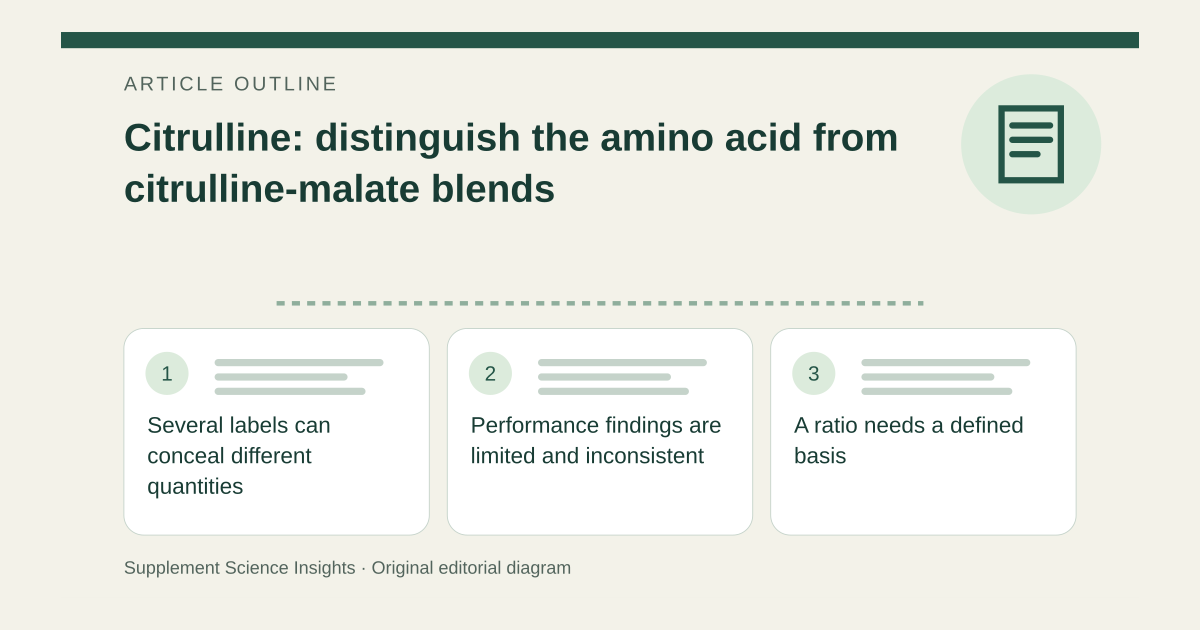
Several labels can conceal different quantities
L-citrulline is an amino acid made in the body and found in foods such as watermelon. The body can convert it to arginine, which participates in nitric-oxide production. Supplements may contain citrulline alone or citrulline malate. [1]
The amount of a citrulline-malate mixture is not automatically the amount of citrulline. Ratios and specifications need to be clear before comparing quantities. A larger blend number may simply include more of another component. [1]
Performance findings are limited and inconsistent
NIH ODS describes relatively few trials with different protocols and mixed results. Some resistance-exercise findings have been favorable, while other exercise tests have not shown benefit. The exact preparation and activity remain part of the result. [1]
Changes in nitric-oxide-related measurements do not directly establish improved athletic performance. A proposed increase in blood flow is a mechanism to investigate, not proof of more strength, faster times or better recovery in every setting. [1]
A ratio needs a defined basis
A label saying 2:1 should explain what is being compared and how the material is specified. Do not assume that every product using that notation has identical composition or that the ratio proves superiority over another preparation.
For a study match, record the actual citrulline quantity if provided, the malate component, the timing and the test. A proprietary blend that hides individual amounts cannot be reconstructed from its total weight or ingredient order. Missing quantities should remain missing rather than being estimated to fit a trial.
Short-term tolerability leaves longer-term questions
Stomach discomfort has been reported in citrulline research. Safety has not been adequately characterized for prolonged supplemental use across populations. A short trial in healthy adults cannot establish safety in a person with a medical condition or a complex medication list. [1]
Assess the complete pre-workout or blend rather than only the citrulline line. This reference does not provide a dose or a method of combining vasodilating products. Product identity and clinical context matter alongside the proposed benefit. [1]
Use an explicitly declared proportion
Imagine a fictional 6 g blend explicitly states that two thirds of its mass is citrulline. The declared citrulline amount is 4 g. A second 6 g product without composition details cannot automatically be assigned the same quantity.
The example depends on the stated mass fraction, not merely a suggestive product name. The calculation does not establish equivalence in performance or a suitable serving.
| Fictional declaration | Citrulline amount |
|---|---|
| 6 g blend; explicit two-thirds fraction | 4 g |
| 6 g blend; composition absent | Unknown |
| Same total mass | Not proven equivalent |
A physiological story needs a measured result
Citrulline claims are most useful when they identify form, actual quantity and the exercise endpoint. This page does not recommend a pre-workout product or rank blends by ratio. A mechanism and a matching total weight are insufficient to establish a clinical or performance effect.
Sources for this article
- NIH ODS — Exercise and athletic performance: professional fact sheet
Source consulted: 2026-09-17. This is a reference resource, not a claim that we conducted the studies or tested a product.