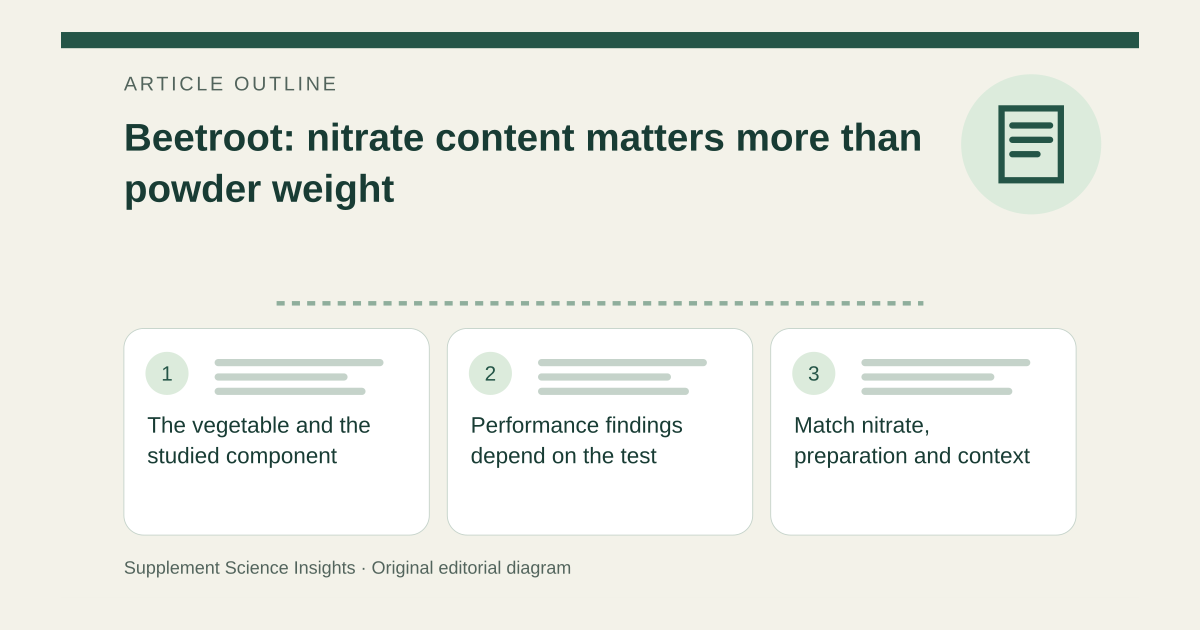
The vegetable and the studied component
Beetroot contains nitrate, which the body can use in pathways involved in nitric oxide production. Interest in exercise performance has focused on nitrate-containing beet juice and related preparations. The amount of beet material is not the same measurement as the amount of nitrate. [1]
A whole vegetable, concentrated juice and dried powder can therefore represent different exposures. The word beetroot on two labels is not enough to establish that they resemble each other or a product used in a trial. [1]
Performance findings depend on the test
The NIH Office of Dietary Supplements describes studies suggesting that beet juice or nitrate may improve some exercise outcomes, alongside inconsistent findings. Results appear more promising in recreationally active people than in highly trained athletes, and they do not establish a benefit for every event. [1]
Distinguish oxygen use at a fixed workload, time to exhaustion and actual time-trial performance. These outcomes answer different questions. Being able to continue a laboratory test longer should not automatically be translated into a guaranteed percentage improvement in a race. [1]
Match nitrate, preparation and context
To assess a supplement claim, look for the nitrate amount actually provided, the preparation studied, the timing and duration of use, and the participants' training level. A vague beet-equivalent amount cannot fill in those missing details.
If nitrate is not disclosed, record it as unknown. Do not estimate it from the powder's color, taste, total weight or the mass of vegetables said to have been used. Those observations do not supply the missing composition measurement.
Short studies leave long-term questions
ODS notes that available short-term studies generally report good tolerability, but long-term safety of concentrated supplemental use has not been well studied. Beet consumption can discolor urine or stools. Do not assume every unexpected symptom has that harmless explanation, especially when it persists or is accompanied by illness. [1]
A person considering concentrated products while managing a medical condition should discuss the actual formula with their clinician. A food's familiar name does not establish the suitability of every extract or combination sold under it. [1]
A larger beet number may tell you less
Imagine label A lists 2,000 milligrams of beetroot powder with no nitrate figure. Label B lists a smaller serving but separately declares 100 milligrams of nitrate. The first label gives more powder information; the second gives a nitrate amount.
Neither label alone proves benefit or identifies a suitable dose. The honest comparison is that A's nitrate exposure remains unknown. It should not be ranked above B simply because its front-label number is twenty times larger. Missing composition data should stay visible in any comparison table.
| Hypothetical label | Disclosed amount | What remains unknown |
|---|---|---|
| A | 2,000 mg beetroot powder | Nitrate content |
| B | 100 mg nitrate | Whether the full preparation matches relevant research |
Sources for this article
- NIH ODS — Exercise and Athletic Performance, professional fact sheet
Source consulted: 2026-09-17. This is a reference resource, not a claim that we conducted the studies or tested a product.