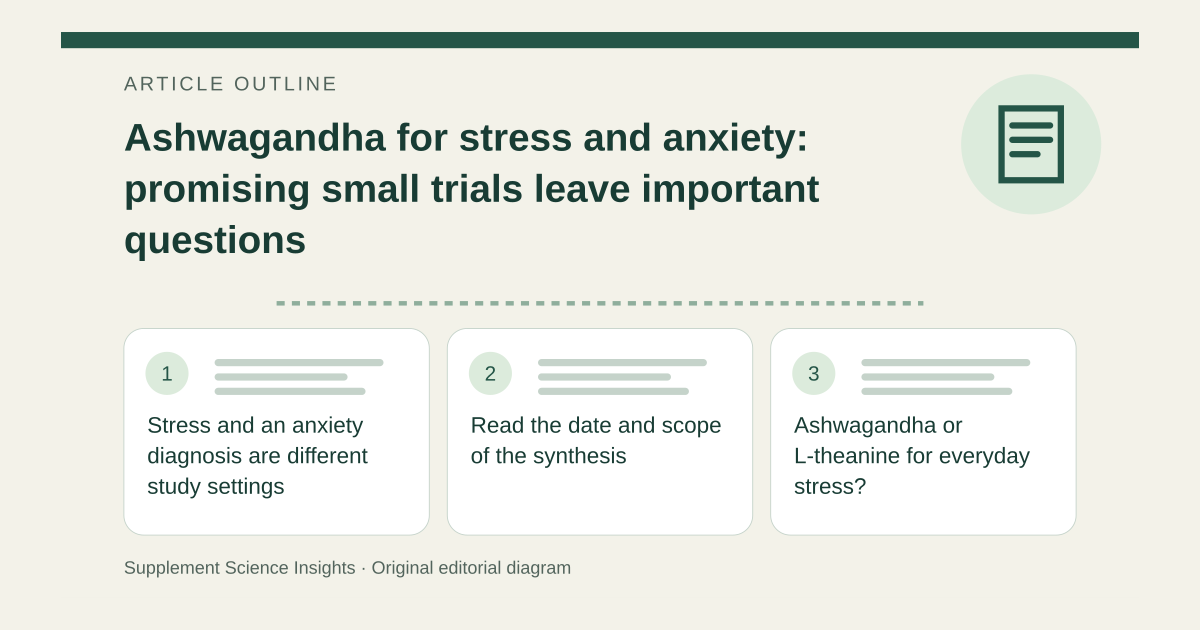
Stress and an anxiety diagnosis are different study settings
The NIH Office of Dietary Supplements describes several relatively small, short studies suggesting improvements in perceived stress or anxiety with ashwagandha. A 2021 review summarized seven studies involving 491 adults, mostly conducted over six to eight weeks. Root, root-and-leaf extracts and other preparations were not interchangeable interventions. [1]
These findings are encouraging but do not establish a response for an individual or an optimal product. Questionnaire changes, cortisol measurements and recovery from a diagnosed anxiety disorder are different outcomes. The participant selection and outcome measured need to stay attached to the result. [1]
Read the date and scope of the synthesis
NCCIH’s March 2023 summary describes potential stress benefit while calling the anxiety evidence unclear. The ODS May 2025 review discusses additional favorable findings but still emphasizes short follow-up, small studies and differences between preparations. These summaries should not be flattened into a claim of established treatment for severe anxiety. [1][2]
Neither summary supplies a universally appropriate dose or a reliable number of days until relief. Persistent anxiety deserves assessment; changing established care on the strength of a supplement claim would go beyond this evidence. [1][2]
Ashwagandha or L-theanine for everyday stress?
The reviewed evidence does not establish a head-to-head winner. NIH ODS summarizes ashwagandha trials using varied extracts and repeated use, while the cited L-theanine trial studied 30 adults over four-week periods. Some L-theanine outcomes improved from baseline without a significant advantage over placebo; those changes should not be treated as proof of broad anxiety-treatment efficacy. [3][4]
Choosing between them requires more than comparing milligrams. Extract identity matters for ashwagandha, and its liver, thyroid and medication cautions can change suitability. The L-theanine study was small and industry-funded, so its findings do not establish long-term safety or superiority. Persistent anxiety deserves assessment rather than a supplement-only comparison. [3][4]
How long until ashwagandha might help?
In the stress studies summarized by ODS, treatment commonly lasted six to eight weeks; sleep studies used six to twelve weeks. Those are study durations, not guaranteed onset times, and results cannot automatically be transferred to a different extract or gummy. Do not interpret the absence of an immediate calming sensation as a reason to increase the dose. [3]
A changed stress score has a specific meaning
Imagine a study enrolls stressed volunteers and reports an improved questionnaire score after eight weeks. That can support a claim about that measure in those volunteers. It cannot establish remission of an anxiety disorder that was not the enrollment criterion.
| Observation | Interpretation |
|---|---|
| Perceived stress score | Measured symptom outcome |
| Cortisol result | Separate biological measure |
| Anxiety-disorder remission | Requires its own evidence |
Sources for this article
- NIH ODS: Ashwagandha — Health Professional Fact Sheet
Source consulted: 2026-09-17. This is a reference resource, not a claim that we conducted the studies or tested a product. - NCCIH: Ashwagandha
Source consulted: 2026-09-17. This is a reference resource, not a claim that we conducted the studies or tested a product. - NIH ODS: Ashwagandha, health professional fact sheet
Source consulted: 2026-09-25. This is a reference resource, not a claim that we conducted the studies or tested a product. - Hidese et al. 2019: L-theanine, stress-related symptoms and cognition, randomized crossover trial
Source consulted: 2026-09-25. This is a reference resource, not a claim that we conducted the studies or tested a product.