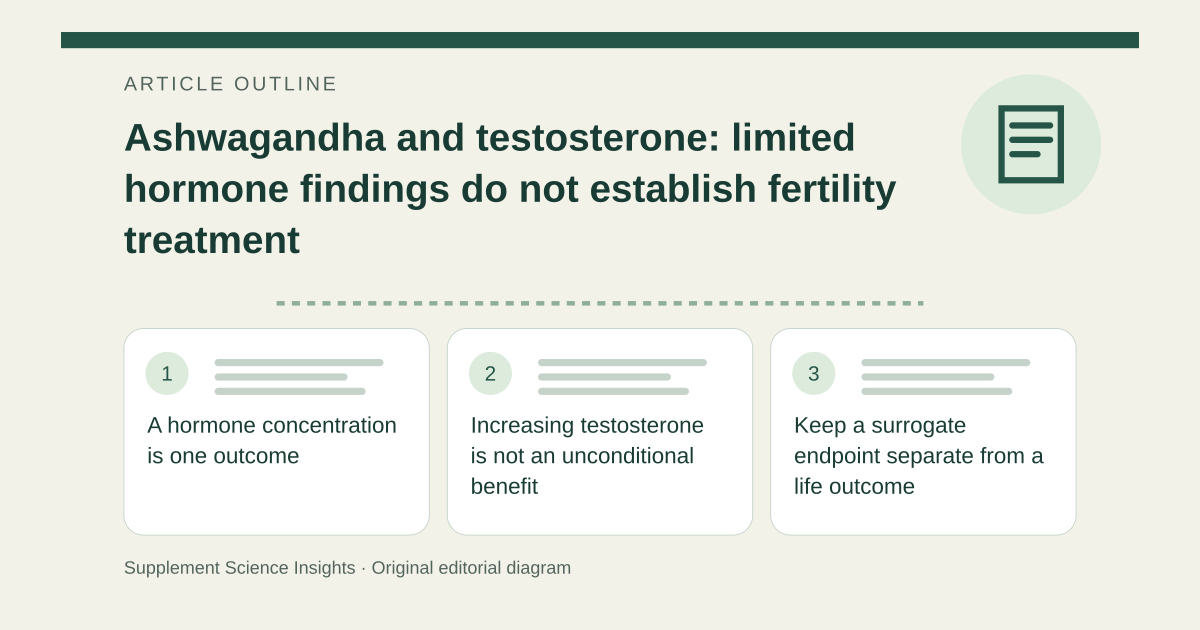
A hormone concentration is one outcome
NCCIH describes limited evidence suggesting that some ashwagandha preparations may increase testosterone and improve sperm quality over two to four months. Limited evidence is not a guarantee of a response, and it does not rank retail extracts. [1]
A change in a laboratory concentration differs from improvement in symptoms, conception or live birth. Fertility depends on more than one measurement. These outcomes need direct study rather than being inferred from a favorable hormone result. [1]
Increasing testosterone is not an unconditional benefit
NCCIH advises avoidance in people with hormone-sensitive prostate cancer because of the possibility of increasing testosterone. ODS also emphasizes uncertainty about optimal preparations and longer-term use. A marketed hormone effect therefore belongs in the safety assessment as well as the benefit claim. [1][2]
Symptoms attributed to low testosterone or difficulty conceiving warrant appropriate assessment. This evidence does not establish a self-treatment dose or justify postponing evaluation while repeatedly switching extracts. A larger labeled amount cannot fill the clinical evidence gap. [1][2]
Keep a surrogate endpoint separate from a life outcome
Imagine a trial reports a higher average testosterone concentration but does not track pregnancies. It answers a hormone question. Describing the result as proven improvement in the chance of having a baby would add an unmeasured outcome.
| Observation | Interpretation |
|---|---|
| Testosterone concentration | Hormone measurement |
| Sperm characteristics | Another measured domain |
| Live birth | Requires direct evidence |
Sources for this article
- NCCIH: Ashwagandha
Source consulted: 2026-09-17. This is a reference resource, not a claim that we conducted the studies or tested a product. - NIH ODS: Ashwagandha — Health Professional Fact Sheet
Source consulted: 2026-09-17. This is a reference resource, not a claim that we conducted the studies or tested a product.