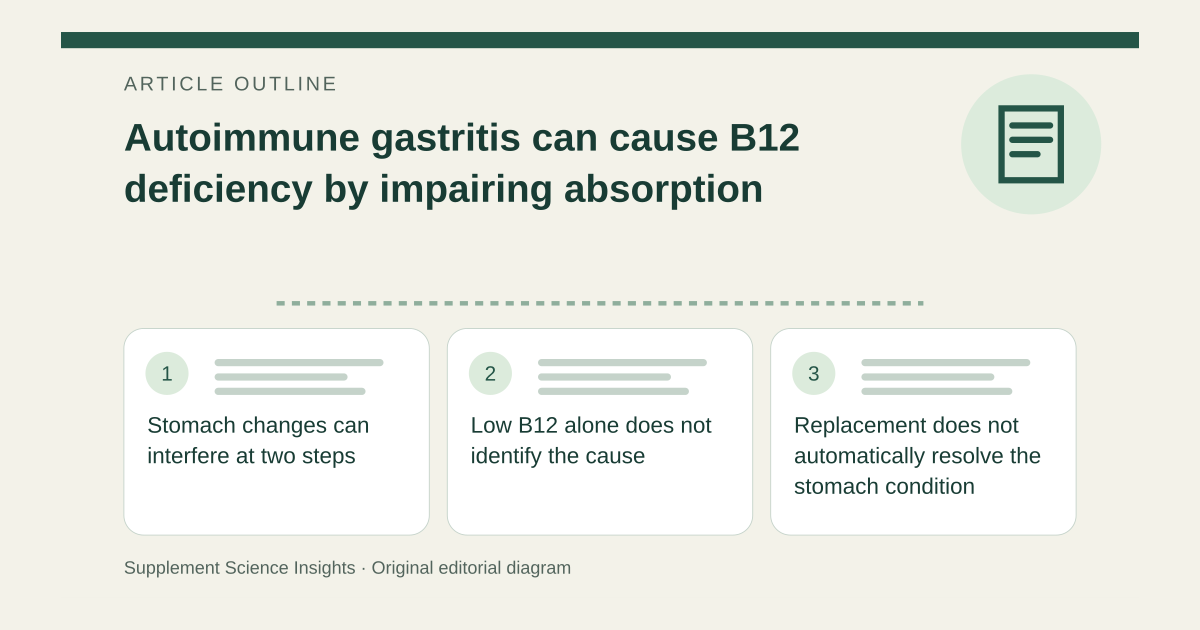
Stomach changes can interfere at two steps
NICE describes autoimmune inflammation that can damage parietal cells in the stomach body. Reduced acid secretion can make it harder to release B12 from food. [1]
Impaired intrinsic-factor production adds another problem, because this protein is important for B12 absorption. These mechanisms explain why adequate dietary intake does not always prevent deficiency. [1]
Low B12 alone does not identify the cause
B12 deficiency has dietary and non-dietary explanations. NICE recommends investigating the suspected cause rather than assuming every low result indicates autoimmune gastritis. [1]
Antibody testing can contribute to the assessment, but a negative intrinsic-factor antibody result does not rule the condition out. Further investigation depends on the clinical situation. [1]
Replacement does not automatically resolve the stomach condition
When absorption is persistently impaired, the replacement plan must account for that continuing cause. Raising B12 intake through ordinary food alone may not address the mechanism. [1]
The underlying gastric diagnosis and the B12 deficiency should therefore both be considered in care. A normal result after treatment does not, by itself, demonstrate that the absorption problem disappeared. [1]
Direction of causation matters
Imagine low B12 is found in someone with confirmed autoimmune gastritis. The evidence supports an absorption explanation; it does not establish that taking too little B12 caused the autoimmune stomach disease.
| Detail | Interpretation |
|---|---|
| Parietal-cell damage | Can reduce acid and intrinsic factor |
| Low B12 | Does not identify the cause alone |
| Replacement plan | Accounts for ongoing malabsorption |
Sources for this article
- Recommendations | Vitamin B12 deficiency in over 16s: diagnosis and management | Guidance | NICE
Source consulted: 2026-09-19. This is a reference resource, not a claim that we conducted the studies or tested a product.