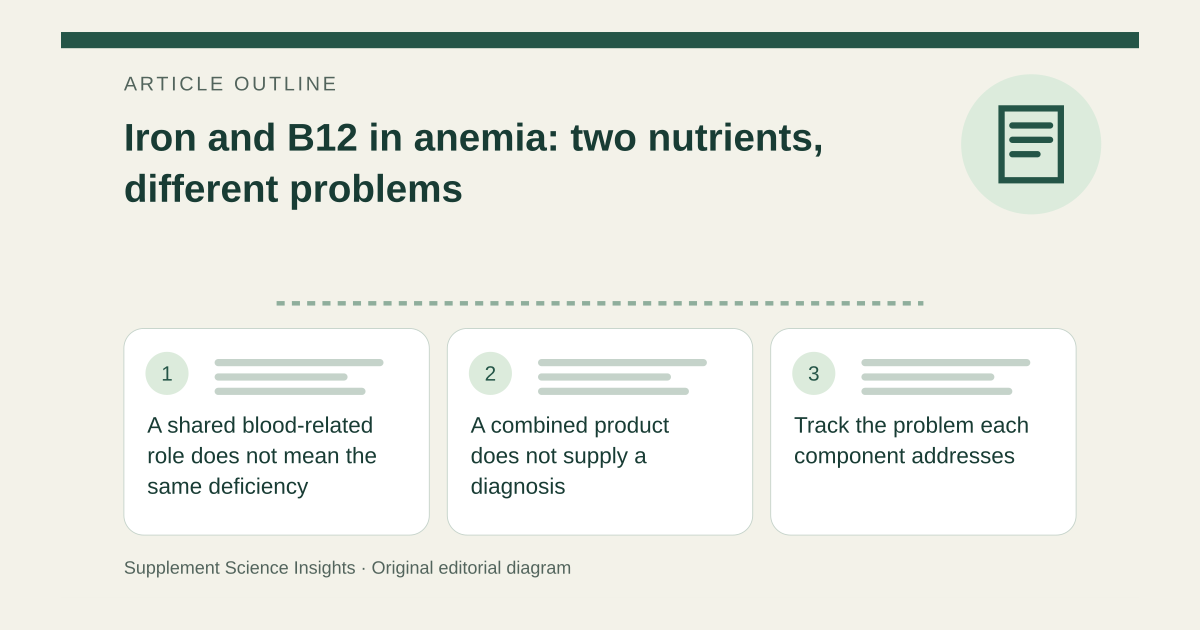
A shared blood-related role does not mean the same deficiency
Iron is part of hemoglobin, the protein that carries oxygen in red blood cells. Vitamin B12 supports DNA synthesis and healthy red-blood-cell formation, among other functions. A shortage of either can contribute to anemia through different mechanisms. [1][2]
A low hemoglobin result identifies anemia, not necessarily its nutritional cause. It does not establish that iron, B12 or both are the missing treatment. Other causes and combinations are possible. [1][2]
A combined product does not supply a diagnosis
A person can need more than one nutrient, but the ingredients in a blood-support blend do not demonstrate that need. Tests, symptoms, diet, absorption and medical history help determine what should be treated. [1][2]
If both nutrients are prescribed, each still needs an appropriate amount, formulation and follow-up. The fact that they share a bottle does not establish that either amount is sufficient, necessary or suitable. A B-complex blend may also contain additional ingredients unrelated to the identified deficiency. [1][2]
Track the problem each component addresses
Ask what evidence supports each nutrient, how response will be assessed and whether the cause of the deficiency has been addressed. Iron can cause gastrointestinal effects and excess can be harmful, so adding it automatically to a B12 regimen is not a neutral choice. [1][2]
These sources explain nutrient roles and assessment. They do not establish a universal combined dose or clear every medication and product combination. [1][2]
A treatment response is not a substitute rule
Imagine B12 treatment corrects a B12-related problem. That does not show that iron would have produced the same response. Conversely, an iron response does not prove that every future episode of anemia has the same cause.
| Detail | Interpretation |
|---|---|
| Iron | Hemoglobin component |
| B12 | Supports DNA and red-cell production |
| Combined use | Requires a reason for each nutrient |
Sources for this article
- NIH ODS: Iron — Health Professional Fact Sheet
Source consulted: 2026-09-17. This is a reference resource, not a claim that we conducted the studies or tested a product. - NIH ODS: VitaminB12 — Health Professional Fact Sheet
Source consulted: 2026-09-17. This is a reference resource, not a claim that we conducted the studies or tested a product.