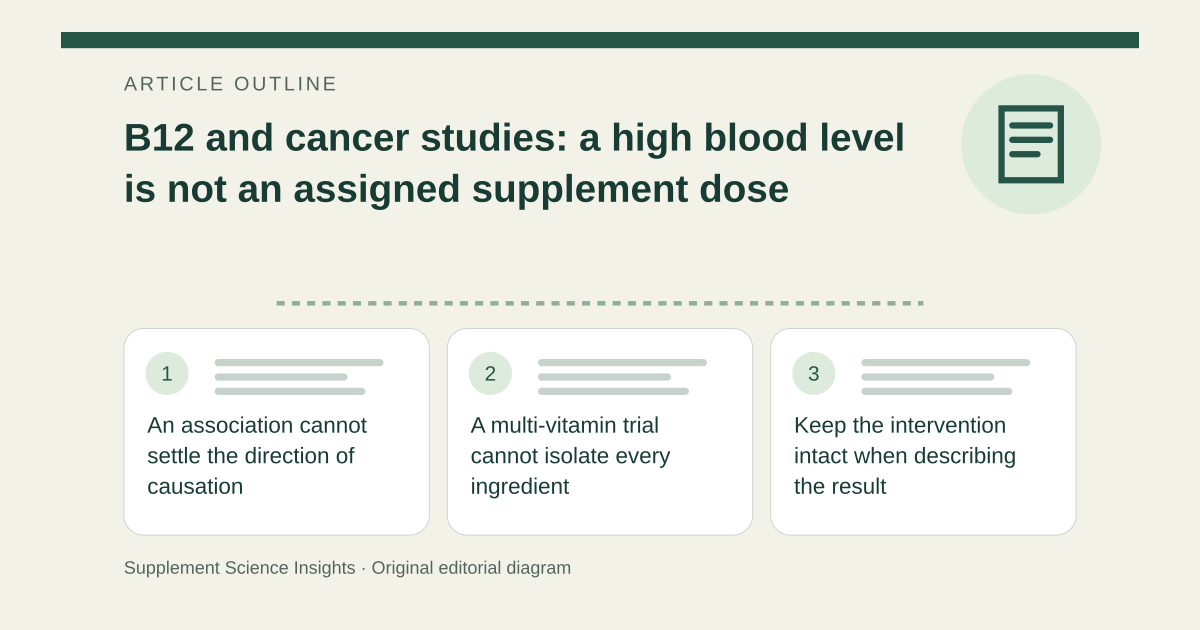
An association cannot settle the direction of causation
The ODS B12 synthesis describes studies linking high blood levels or supplement use with some cancer outcomes, alongside studies finding no association and others linking lower levels with higher risk. That mixed record does not support a universal causal statement. [1]
A blood concentration is not the same exposure as a randomized supplement dose. An observational association can reflect other characteristics or disease-related changes, so it cannot prove that taking B12 produced the cancer. [1]
A multi-vitamin trial cannot isolate every ingredient
Some trials combined B12 with folic acid or other B vitamins. ODS notes that an effect in such a trial may not be attributable to B12 alone, and that pooled randomized evidence has found little or no effect on several cancer endpoints. [1]
The source concludes that more evidence is needed to clarify the relationship. This uncertainty is neither a reason to use high doses for cancer prevention nor a basis to discontinue prescribed deficiency treatment without discussing it with the clinician. [1]
Keep the intervention intact when describing the result
Imagine a trial assigns folic acid plus B12 and observes a difference in one cancer outcome. Rewriting the result as “B12 alone caused the difference” removes part of the intervention. The combination, endpoint and uncertainty should remain attached to the finding.
| Finding | Interpretation |
|---|---|
| B12 plus another vitamin | Assigned combination |
| One observed endpoint | The measured result |
| B12 alone caused it | Not isolated by that comparison |
Sources for this article
- NIH ODS: Vitamin B12
Source consulted: 2026-09-17. This is a reference resource, not a claim that we conducted the studies or tested a product.