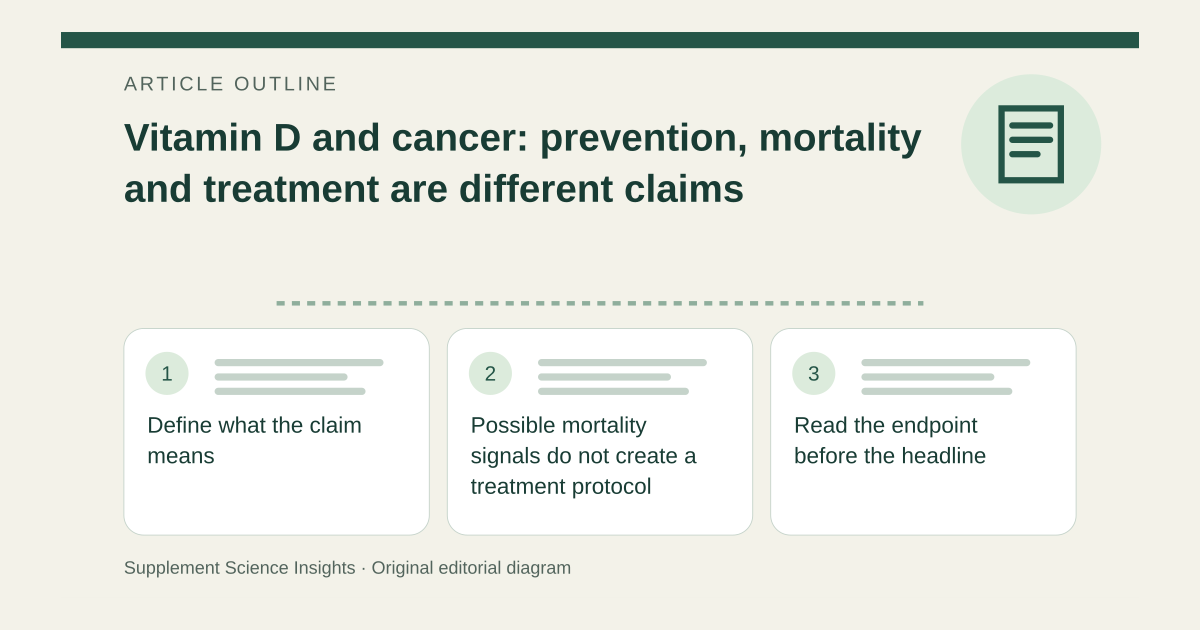
Define what the claim means
A cancer claim may concern fewer new diagnoses, longer survival after diagnosis, or response to treatment. These outcomes require different studies. A nutrient’s role in cellular biology is not itself evidence for any of them. [1]
In its June 2025 summary, ODS concludes that studies do not indicate reduced cancer incidence with vitamin D supplementation, with or without calcium. It discusses possible mortality relationships and continuing uncertainty rather than an established universal benefit. [1]
Possible mortality signals do not create a treatment protocol
A study of cancer mortality cannot be translated directly into a dose for shrinking an existing tumor. Participants, baseline vitamin D status, cancer types and interventions matter, and a pooled result does not establish the same effect in every setting. [1]
Nutritional deficiency can still warrant assessment during cancer care. That decision belongs within the treatment plan; adding high amounts on the assumption that more vitamin D fights cancer risks toxicity without establishing benefit. This page is a scoped reading of the ODS synthesis, not a new review of all oncology trials. [1]
Read the endpoint before the headline
Imagine a report describes fewer deaths in one analysis but no reduction in new cancer diagnoses. Calling that “prevents cancer” changes the measured outcome. Calling it “treats tumors” adds a further claim that the comparison may never have tested.
| Observation | Meaning |
|---|---|
| New cancer diagnoses | Incidence |
| Deaths during follow-up | Mortality |
| Tumor response | A treatment endpoint |
Sources for this article
- NIH ODS: Vitamin D
Source consulted: 2026-09-17. This is a reference resource, not a claim that we conducted the studies or tested a product.