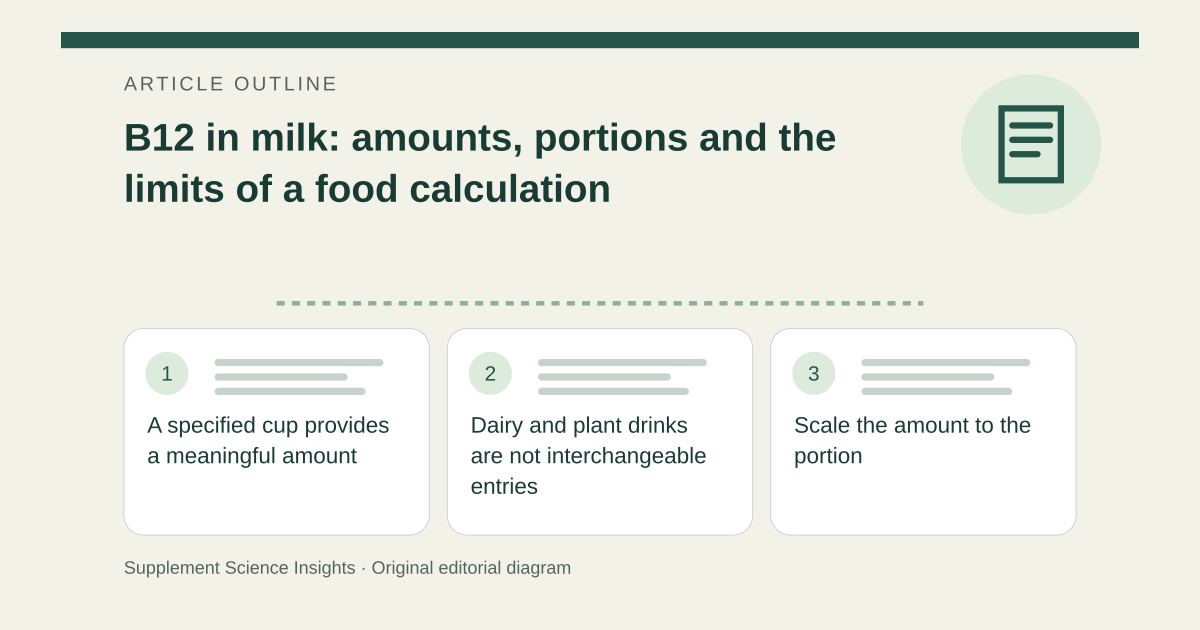
A specified cup provides a meaningful amount
The NIH ODS food table lists 1.3 micrograms of vitamin B12 in one cup of milk with 2% milkfat. Relative to the adult Daily Value of 2.4 micrograms, that is approximately 54%. The portion and milk type belong with the number; “milk contains B12” is not enough for an intake calculation. [1]
The table is a food-composition reference, not a measurement of every carton. Use an actual product label or an appropriate food database entry when the type, fortification or serving differs. A splash in coffee is not equivalent to the table’s full cup. [1]
Dairy and plant drinks are not interchangeable entries
Dairy foods are natural B12 sources. Plant-based drinks can provide B12 when fortified, but the amount must come from the specific label. A product marketed as a milk alternative should not automatically inherit the B12 value for cow’s milk. [1]
The same principle applies to dairy substitutions: yogurt, cheese and milk have different portions and composition entries. Do not substitute a yogurt container for a cup of milk in a calculation while keeping the milk’s B12 amount unchanged. [1]
Scale the amount to the portion
Using the ODS reference value in a hypothetical portion calculation, half a cup supplies about 0.65 micrograms and two cups about 2.6 micrograms. One cup supplies 1.3 ÷ 2.4 × 100, or about 54% of the adult Daily Value. These are proportional estimates based on the reference entry. [1]
Two cups would exceed the adult RDA numerically, but this is not advice to drink that quantity or a claim that milk alone is an adequate diet. It also does not establish how much B12 a particular person absorbs. [1]
| Portion | Estimated B12 supplied |
|---|---|
| Half a cup | 0.65 micrograms |
| One cup | 1.3 micrograms |
| Two cups | 2.6 micrograms |
Food content is not a deficiency-treatment result
B12 in food must be released during digestion and then absorbed through a pathway involving intrinsic factor and the small intestine. Difficulty with those steps can produce deficiency despite apparently adequate intake. Increasing milk does not by itself diagnose or correct the underlying problem. [1]
The ODS summary notes that B12 bioavailability varies by food and amount. It is therefore better to describe the table number as B12 supplied, rather than promising that the entire amount enters the bloodstream. [1]
Use the food number for dietary planning
Someone who avoids dairy needs another reliable B12 source; milk is not uniquely required. Fortified foods or supplements can meet different dietary needs, while a diagnosed deficiency may require a clinician-directed replacement plan. Do not use a food arithmetic exercise to replace that plan. [1]
This article uses the adult reference for its percentage calculation. Requirements differ during pregnancy and lactation and in children. It makes no infant-feeding recommendation and selects no retail milk or supplement product. [1]
Sources for this article
- NIH ODS — Vitamin B12: Health Professional Fact Sheet
Source consulted: 2026-09-17. This is a reference resource, not a claim that we conducted the studies or tested a product.