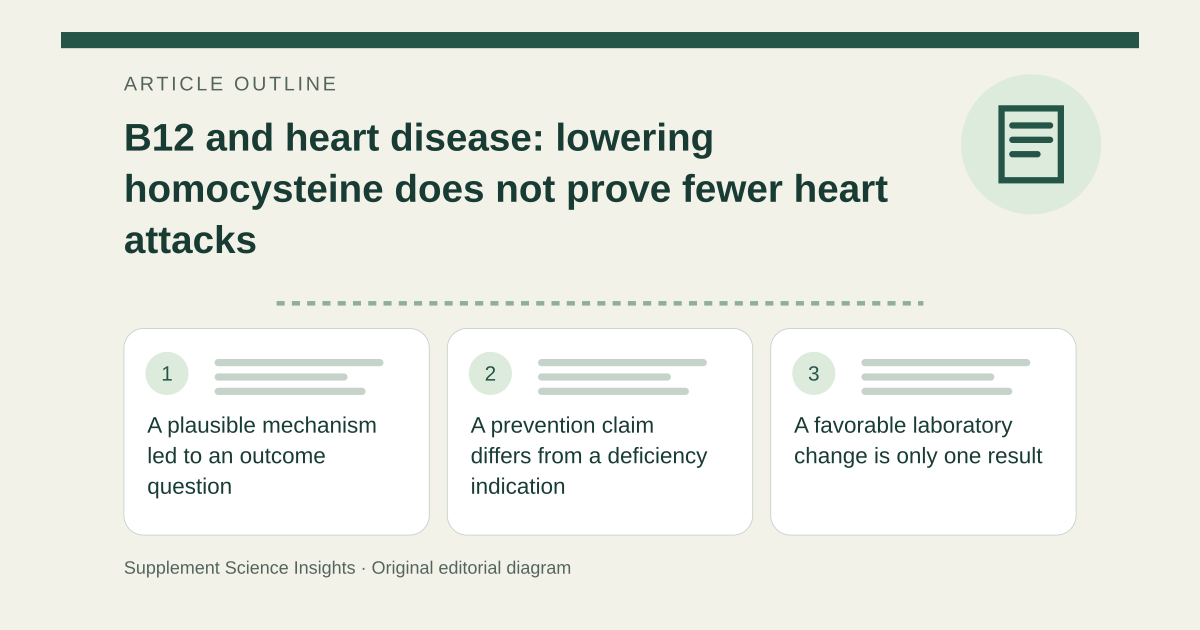
A plausible mechanism led to an outcome question
Higher homocysteine has been associated with cardiovascular risk, and B12 and other B vitamins participate in its metabolism. Researchers therefore tested whether lowering the marker through supplementation would improve cardiovascular outcomes. [1]
ODS reports that randomized trials can lower homocysteine without demonstrating the expected reduction in cardiovascular risk. The marker response should not be presented as proof of fewer heart attacks or longer survival. [1]
A prevention claim differs from a deficiency indication
The ODS synthesis concludes that available evidence does not establish reduced cardiovascular disease or cardiovascular mortality with B12 alone or combined with other B vitamins. It does not follow that a person with heart disease should leave an actual B12 deficiency untreated. [1]
B12 has no established tolerable upper intake limit because of its low toxicity potential. That fact is not proof that an arbitrary high dose or a multi-ingredient product is useful or appropriate. Review the actual reason for treatment and complete product with the clinician. [1]
A favorable laboratory change is only one result
Imagine a trial shows lower homocysteine while heart-attack rates remain unchanged. Reporting only the laboratory finding would omit the outcome that matters to a prevention claim. State both results rather than treating the marker as a substitute.
| Finding | Interpretation |
|---|---|
| Homocysteine decreases | Biochemical result |
| Heart attacks unchanged | Clinical outcome |
| Proven prevention | Does not follow from the marker alone |
Sources for this article
- NIH ODS: Vitamin B12
Source consulted: 2026-09-17. This is a reference resource, not a claim that we conducted the studies or tested a product.