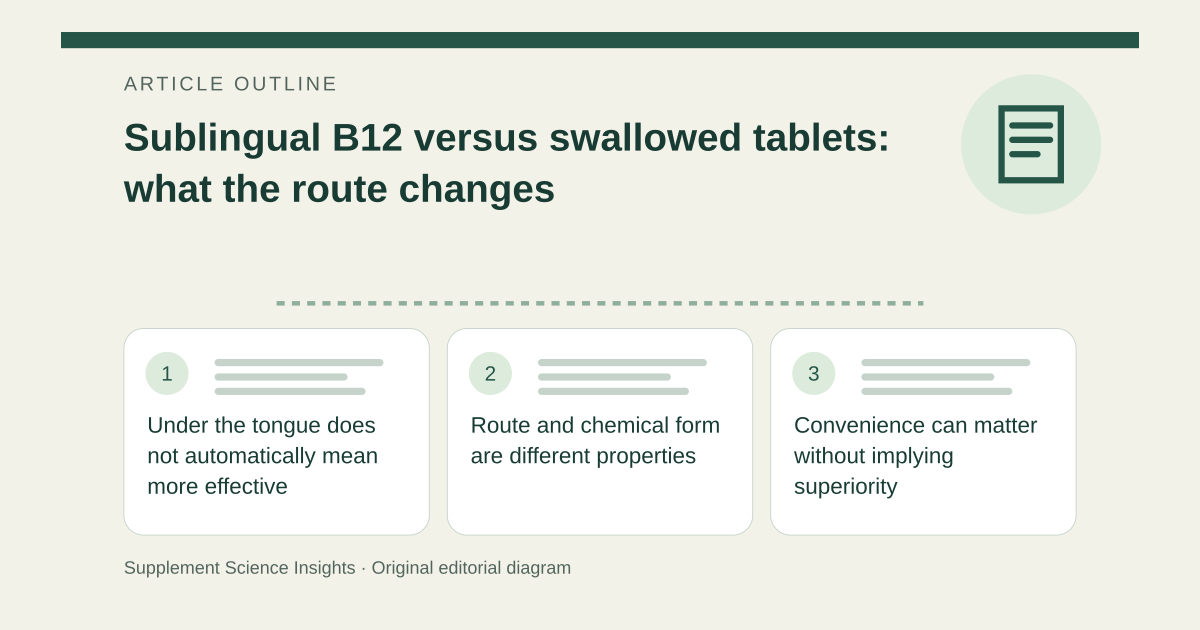
Under the tongue does not automatically mean more effective
Sublingual B12 products are intended to dissolve under the tongue rather than being swallowed as an ordinary tablet. NIH ODS states that available evidence suggests no difference in efficacy between oral and sublingual B12 preparations. The route name alone therefore does not establish a clinical advantage. [1]
That summary does not prove that every retail product is identical or that every cause of deficiency can be managed in the same way. It answers the narrower marketing claim that placing a preparation under the tongue necessarily makes it better. [1]
Route and chemical form are different properties
“Sublingual” describes how a preparation is used. “Methylcobalamin” and “cyanocobalamin” identify chemical forms of B12. A label can contain both terms, but evidence about one property should not be silently treated as proof about the other. [1]
ODS also reports no evidence that absorption rates differ by supplemental B12 form. A claim that an “active” form plus a sublingual route must outperform a swallowed tablet therefore needs direct supporting evidence, not two appealing label descriptions. [1]
Convenience can matter without implying superiority
If a clinician considers more than one preparation appropriate, a person may find one easier to use consistently. That is a practical preference. It is different from showing that one route produces better neurological recovery, symptom relief or long-term outcomes. [1][2]
Treatment of diagnosed deficiency depends on its cause. NICE gives different advice for malabsorption, diet-related deficiency and medicine-related deficiency. An under-the-tongue product should not be assumed to replace an injection or a prescribed oral regimen simply because it is marketed as bypassing digestion. [1][2]
Compare what a claim actually says
Consider two hypothetical packages that both declare the same amount of B12: one says “sublingual methylcobalamin,” and the other “oral cyanocobalamin.” There are at least three separate comparison fields: declared amount, chemical form and route. Equal amounts do not independently prove equal absorbed doses; different routes do not independently prove superior results.
For a superiority claim, ask what outcome was measured, in which participants and with which preparations. A retail slogan cannot supply the missing comparison. This exercise does not recommend either hypothetical product.
| Field | Package A | Package B |
|---|---|---|
| Route | Sublingual | Swallowed oral tablet |
| Form | Methylcobalamin | Cyanocobalamin |
| Declared amount | Same hypothetical amount | Same hypothetical amount |
| Proven clinical superiority | Not established by the label | Not established by the label |
Do not switch a deficiency regimen on a route claim
If B12 replacement has been prescribed, discuss a proposed switch and how response will be assessed. NICE notes that dose, frequency and route sometimes need adjustment for treatment to work properly. A convenient presentation is useful only when it fits the actual treatment plan. [2][1]
This page reports the NIH synthesis rather than claiming a new head-to-head review of all B12 products. Underlying studies have not been independently reappraised here, and no exact retail preparation is recommended. [2][1]
Sources for this article
- NIH ODS — Vitamin B12: Health Professional Fact Sheet
Source consulted: 2026-09-17. This is a reference resource, not a claim that we conducted the studies or tested a product. - NICE NG239 — Vitamin B12 deficiency in over 16s: recommendations
Source consulted: 2026-09-17. This is a reference resource, not a claim that we conducted the studies or tested a product.