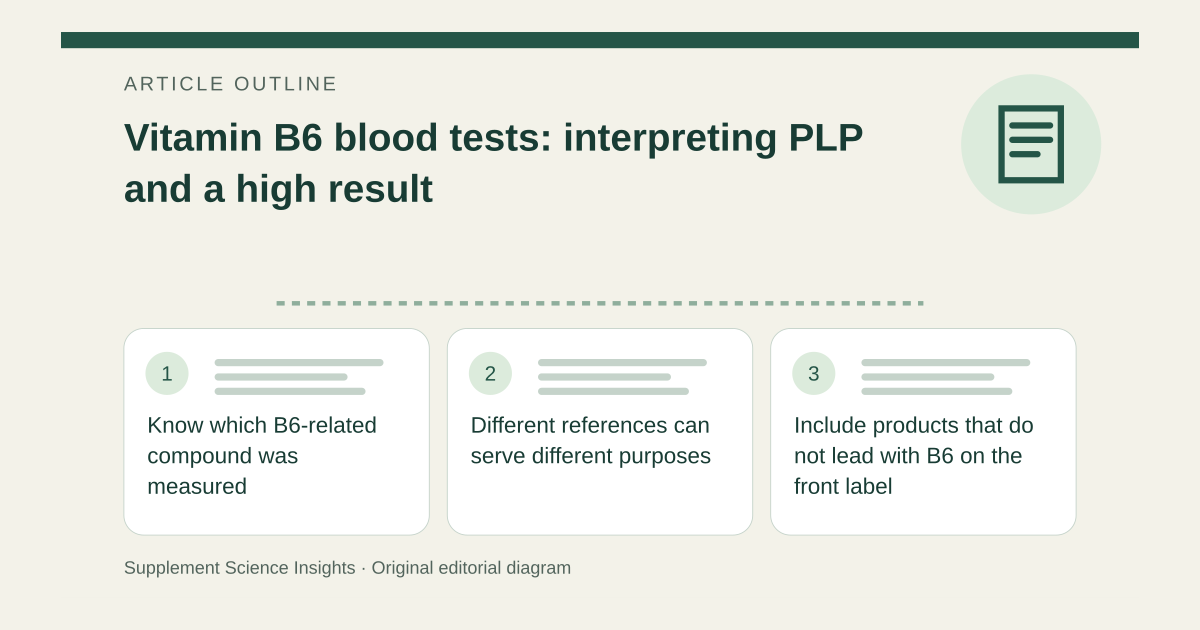
Know which B6-related compound was measured
Vitamin B6 is a family of related compounds. Plasma pyridoxal 5-phosphate, usually abbreviated PLP, is the most common status measure described by ODS. Other methods and specimens are also used. [1]
A report labeled vitamin B6 should therefore be read with its method, units and reference interval. A value expressed in one unit cannot be compared directly with an online value expressed in another. [1]
Different references can serve different purposes
ODS notes that a plasma PLP concentration above 30 nmol/L has traditionally indicated adequate adult status, while the Food and Nutrition Board used 20 nmol/L when developing intake recommendations. These statements describe reference uses, not a universal boundary for every clinical decision. [1]
They also do not define a toxicity threshold. A high value requires review of actual supplement exposure, symptoms and the clinical reason for testing rather than diagnosis from a number alone. [1]
Include products that do not lead with B6 on the front label
Imagine someone with a high B6 result reports no separate B6 tablet but uses a multivitamin and another combination supplement. Their ingredient lists may reveal B6 that was not initially counted.
The exact amounts and duration help the clinician interpret exposure. They do not, by themselves, prove that every symptom is due to B6.
| Observation | Interpretation |
|---|---|
| Analyte and specimen | Identify the actual measurement |
| Units and laboratory interval | Preserve the comparison basis |
| Supplement amounts and duration | Add relevant exposure context |
Review symptoms without escalating intake
Excess supplemental B6 can cause sensory neuropathy. New neurological symptoms should not prompt an automatic increase on the assumption that all such symptoms signal deficiency. [1]
This page explains the test context and does not prescribe a washout period, retesting interval or treatment. Those depend on the clinical situation and the laboratory’s instructions. [1]
Sources for this article
- NIH ODS — Vitamin B6: Health Professional Fact Sheet
Source consulted: 2026-09-17. This is a reference resource, not a claim that we conducted the studies or tested a product.