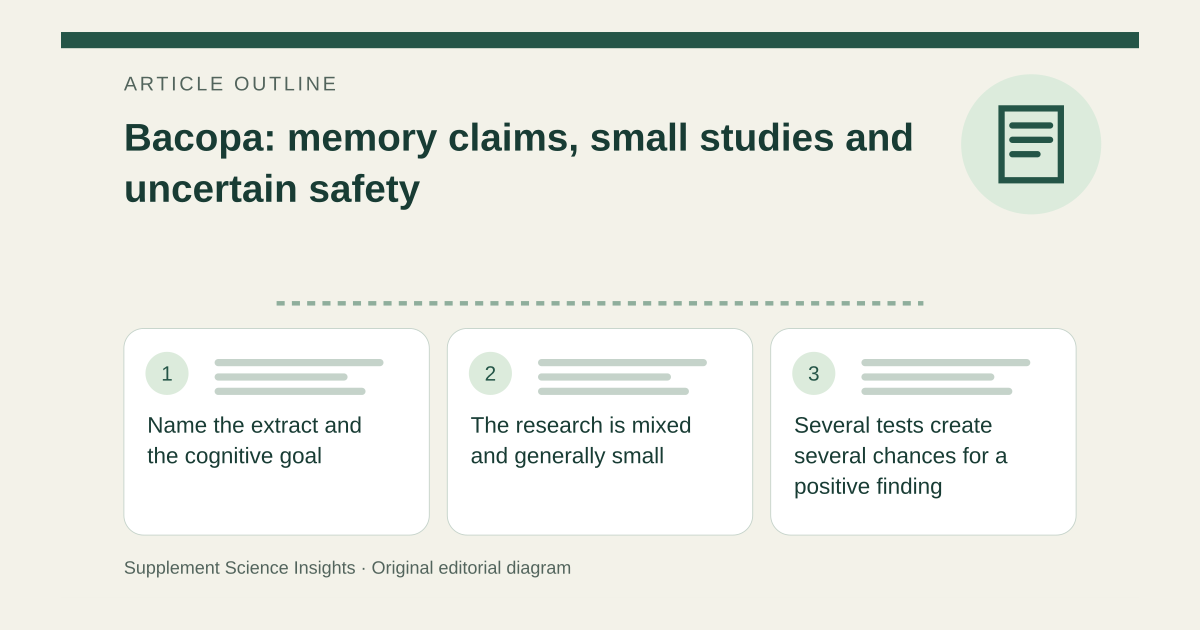
Name the extract and the cognitive goal
Bacopa monnieri is often called brahmi and appears in products marketed for memory and concentration. A common name, extract amount or brain-health category does not establish that the product matches a preparation used in research. [1]
Start with a specific goal: remembering information after a delay, sustaining attention and completing a task quickly are different questions. A useful comparison names the actual extract and the outcome rather than treating all cognitive functions as one interchangeable benefit. [1]
The research is mixed and generally small
Operation Supplement Safety describes small studies with differing products and cognitive tests. Some findings are favorable and others are not; higher amounts have not consistently performed better. Its assessment does not establish a reliable brain-health benefit. [1]
That summary should not be stretched into a conclusion that bacopa treats dementia or that one amount works for everyone. A product with additional ingredients also cannot borrow an isolated-bacopa result as proof of the complete blend's effect. [1]
Several tests create several chances for a positive finding
Imagine a study measuring attention, recall, reaction time and mood. A favorable result on one task should remain attached to that task. It should not be rewritten as improvement in all four areas, especially if the others were unchanged.
Check whether the endpoint was chosen in advance and whether the result was compared with an appropriate control. Familiarity with repeated tasks and differences between participants can complicate interpretation. A short laboratory test also does not directly measure performance during an ordinary workday, academic success or maintained independence.
A short study cannot establish indefinite safety
Reported adverse effects in the OPSS summary include dry mouth, nausea, diarrhea and fatigue. Safety information for longer use and higher exposure remains uncertain. A familiar traditional-use history does not answer those missing questions. [1]
An absence of a listed adverse event in a small study is not proof that it cannot occur. Record the entire product and other treatments when seeking professional advice. This page does not provide a dose-escalation plan or suggest that more is better. [1]
Separate speed from accuracy
Imagine a fictional cognitive trial finds that participants finish a task faster but make more errors. Calling the result improved cognition would conceal the tradeoff. Speed and accuracy should be reported separately, along with the comparison group.
If a combined performance score was specified, its calculation also needs to be clear. The example is not a finding from an actual bacopa study; it shows how a broad claim can outrun a narrower measurement.
| Hypothetical outcome | Interpretation |
|---|---|
| Faster completion | Speed improved |
| More errors | Accuracy worsened |
| Broad cognition claim | Conceals a tradeoff |
Read the outcome before accepting the category
For bacopa, the useful evidence question is about a defined preparation and cognitive task, with uncertainty and adverse effects retained. This reference does not recommend it for cognitive symptoms or promise an everyday performance improvement from a laboratory result.
Sources for this article
- OPSS — Bacopa monnieri: dietary supplements for brain health
Source consulted: 2026-09-17. This is a reference resource, not a claim that we conducted the studies or tested a product.