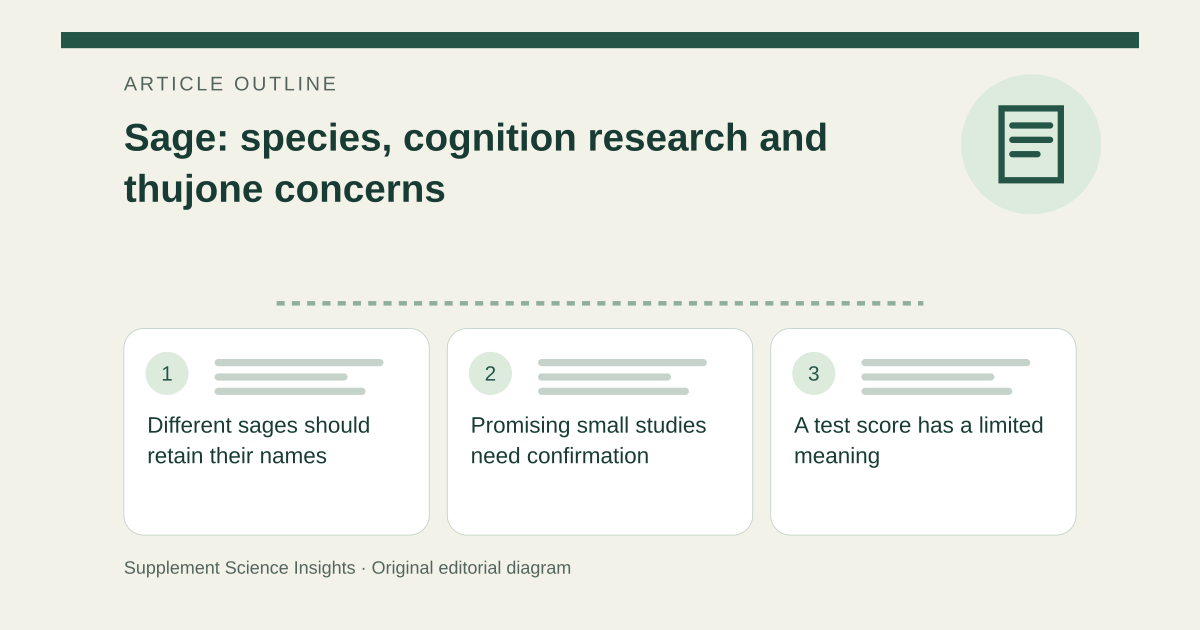
Different sages should retain their names
Common sage and Spanish sage are different botanical materials, and some studies have tested combinations. A reference to sage alone can conceal the species, plant part or preparation that was actually used. [1]
Culinary amounts, concentrated extracts and oils also differ. A food tradition does not establish that any concentrated product is appropriate to swallow. For a research comparison, record the species and route first, then consider whether the retail formulation has a defensible match. [1]
Promising small studies need confirmation
NCCIH describes a few small studies suggesting fewer menopausal hot flashes or improved scores on some cognitive tests. The evidence is limited, and definitive conclusions cannot be drawn. Research in healthy participants does not settle use in Alzheimer’s disease. [1]
Some lipid findings are also preliminary, while glucose evidence is insufficient. These are separate clinical questions. A product should not combine them into an established general benefit merely because the studies involve related botanical names. [1]
A test score has a limited meaning
A memory or attention task can reveal a specific performance difference under study conditions. It does not automatically show improved daily functioning, prevention of cognitive decline or treatment of dementia.
Check whether the study measured several tasks and whether the highlighted result was one of many comparisons. Repeated testing can also improve familiarity with a task. A credible comparator and a prespecified endpoint help interpret the result, while a headline saying sharper thinking may obscure what was actually measured.
Thujone makes concentration relevant
Some sage species, including common sage, contain thujone, which can be toxic at high exposure. NCCIH cautions about high amounts and prolonged use. Short research periods and ordinary culinary use do not establish unrestricted safety for concentrated preparations. [1]
Pregnancy use may be unsafe because of thujone, and breastfeeding information is limited. The absence of a constituent amount on a package does not establish its absence from the product. This reference does not provide a home-extraction method or essential-oil ingestion instructions. [1]
Do not transfer a result across species and routes
Imagine a fictional cognitive study uses a defined common-sage extract capsule. A Spanish-sage fragrance oil differs in species, preparation and route. The study cannot establish a matching effect from the fragrance product.
Even if both labels print 100 mg, their composition and exposure are not thereby equivalent. The hypothetical comparison identifies missing information rather than a conversion or dose recommendation.
| Fictional comparison | Unresolved difference |
|---|---|
| Common-sage capsule | Specified oral preparation |
| Spanish-sage fragrance oil | Species and route differ |
| Same printed mass | No equivalence established |
Keep culinary and therapeutic questions distinct
Sage can be used for flavor without a medical claim. For a supplement, the exact species and formulation matter alongside limited evidence and thujone-related concerns. This overview does not recommend sage for menopause, dementia or metabolic disease.
Sources for this article
- NCCIH — Sage: Usefulness and Safety
Source consulted: 2026-09-17. This is a reference resource, not a claim that we conducted the studies or tested a product.