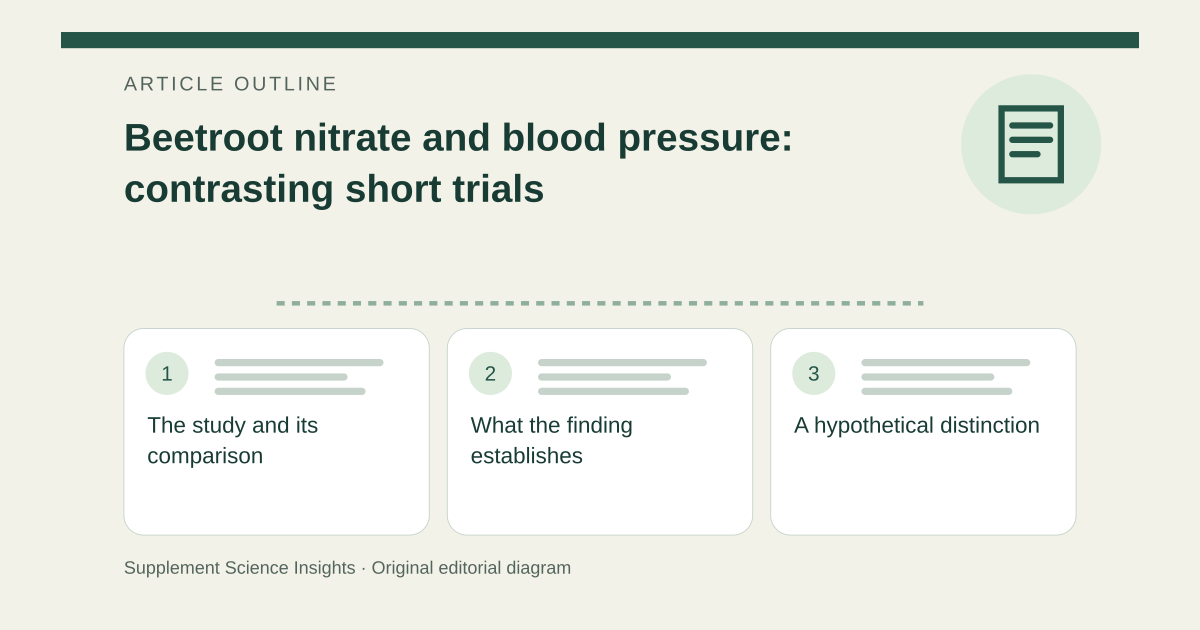
The study and its comparison
The randomized research included 68 participants. Its population was treated and untreated adults with hypertension. The comparison used nitrate-rich beetroot juice 250 ml daily versus nitrate-depleted juice, with observation over four weeks. [1][2]
The larger trial reported lower clinic, home and ambulatory pressure; ambulatory reduction was approximately 7.7/5.2 mm Hg. A separate crossover trial in twenty-seven treated patients found no home or ambulatory benefit after one week despite increased nitrate metabolites. [1][2]
What the finding establishes
Different treatment status and duration limit direct comparison. The contrast shows why a biochemical rise does not guarantee a clinical response. Neither trial establishes prevention of stroke or a universally best nitric-oxide supplement. The four-week study was funded by the British Heart Foundation; complete conflicts were not established. [1][2]
A hypothetical distinction
Imagine nitrate metabolites increase without a pressure change. Evidence that the preparation was absorbed is not evidence of the intended benefit.
| Detail | Interpretation |
|---|---|
| Measured outcome | Keep the endpoint specific |
| Study preparation | Not every retail product |
| Remaining uncertainty | Not resolved by a mechanism |
Sources for this article
- Dietary nitrate provides sustained blood pressure lowering in hypertensive patients: a randomized, phase 2, double-blind, placebo-controlled study.
Source consulted: 2026-09-19. This is a reference resource, not a claim that we conducted the studies or tested a product. - Absence of an effect of high nitrate intake from beetroot juice on blood pressure in treated hypertensive individuals: a randomized controlled trial.
Source consulted: 2026-09-19. This is a reference resource, not a claim that we conducted the studies or tested a product.