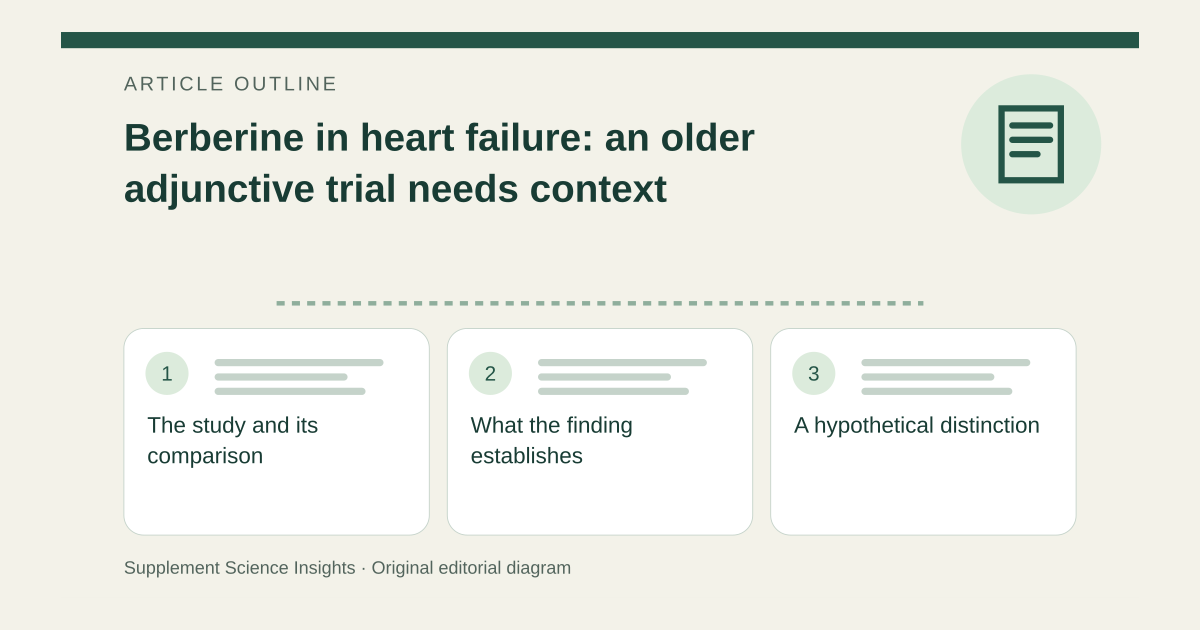
The study and its comparison
A randomized trial included 156 participants. The study population was heart-failure patients with frequent ventricular ectopy or nonsustained ventricular tachycardia. Researchers compared berberine 1.2 to 2 g daily versus placebo with conventional treatment, with follow-up over eight-week assessment and mean twenty-four-month follow-up. [1]
The report describes greater improvement in ejection fraction, walking capacity and symptoms, with fewer ventricular premature beats. It also reports seven deaths with berberine and thirteen with placebo during longer follow-up. [1]
What the finding establishes
The mortality counts are small, and the abstract provides insufficient detail to independently evaluate its survival analysis. Background treatment reflects an older era. A favorable small trial does not establish equivalence to current heart-failure therapy, ordinary blood-pressure control or comprehensive arrhythmia safety. Funding and complete conflicts were not established from the retrieved abstract. [1]
A hypothetical distinction
Imagine an older study reports a mortality advantage from a few events. Replication and the full statistical method matter before treating that result as settled.
| Detail | Interpretation |
|---|---|
| Measured outcome | Keep the endpoint specific |
| Study preparation | Not every retail product |
| Remaining uncertainty | Not resolved by a mechanism |
Sources for this article
- Efficacy and safety of berberine for congestive heart failure secondary to ischemic or idiopathic dilated cardiomyopathy.
Source consulted: 2026-09-19. This is a reference resource, not a claim that we conducted the studies or tested a product.