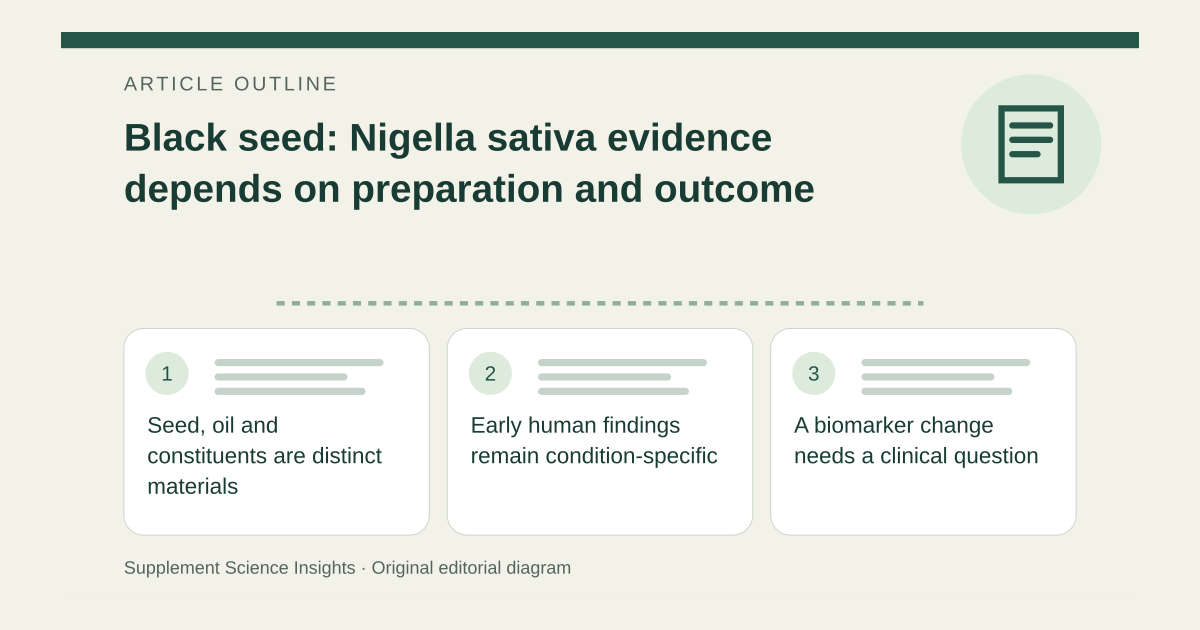
Seed, oil and constituents are distinct materials
Black seed commonly refers to Nigella sativa, also called black cumin or kalonji. Products may contain seeds, oil or an extract and may highlight thymoquinone. Total oil mass is not automatically the amount of that constituent. [1]
Identify the botanical name and preparation before comparing a claim. Similar common names can create confusion, while a shared botanical source does not establish matching composition between an oil and a powder. A study needs to retain the material that participants actually received. [1]
Early human findings remain condition-specific
Memorial Sloan Kettering summarizes small clinical studies across several conditions, including diabetes and asthma, with conflicting blood-pressure findings. These results require confirmation and should not be treated as established treatment recommendations. [1]
Laboratory anticancer findings do not establish cancer treatment in people. Likewise, a study of a topical preparation for a treatment-related skin problem is not evidence that an oral product treats the cancer itself. The route and clinical purpose remain essential. [1]
A biomarker change needs a clinical question
When a product promises to reduce inflammation, ask what was measured and in whom. A change in a laboratory marker does not automatically imply less pain, better breathing, improved function or fewer complications. Those outcomes need direct measurement.
Also examine the comparison and background care. An add-on study tests whether an intervention contributes to an existing treatment, not whether it can replace that treatment. A formula containing honey or other ingredients raises another attribution question because the effect of the complete mixture cannot be assigned to black seed alone.
Uncertainty about interactions should stay explicit
Topical oil has caused allergic skin reactions. Laboratory findings suggest possible interactions involving drug-metabolizing enzymes and warfarin-related activity, but their clinical significance is not established. This is a reason to review medicines professionally, not to invent a predictable dose adjustment. [1]
Animal findings at high exposure cannot supply a human safety threshold. Nor does a lack of such a threshold establish unrestricted safety. This overview does not provide use instructions during cancer treatment or for a vulnerable population. [1]
Distinguish total oil from a declared component
Imagine a fictional serving lists 1,000 mg black-seed oil standardized to 1 percent thymoquinone. The declared thymoquinone amount is 10 mg. A second 1,000 mg oil product without a percentage leaves that quantity unknown.
The arithmetic does not establish absorption, effectiveness or an appropriate amount. A higher percentage also cannot be ranked as better without clinical and safety evidence for the resulting preparation.
| Fictional declaration | What it establishes |
|---|---|
| 1,000 mg oil; 1% thymoquinone | 10 mg declared constituent |
| Oil amount only | Constituent amount unknown |
| Calculated composition | Not proof of clinical benefit |
Keep the promise narrower than the marketing
Black-seed research deserves preparation-specific reading. This page does not recommend a product or replace treatment for diabetes, asthma or cancer. A clear account preserves both the preliminary nature of the findings and the difference between a chemical explanation and a demonstrated patient benefit.
Sources for this article
- Memorial Sloan Kettering — Nigella sativa
Source consulted: 2026-09-17. This is a reference resource, not a claim that we conducted the studies or tested a product.