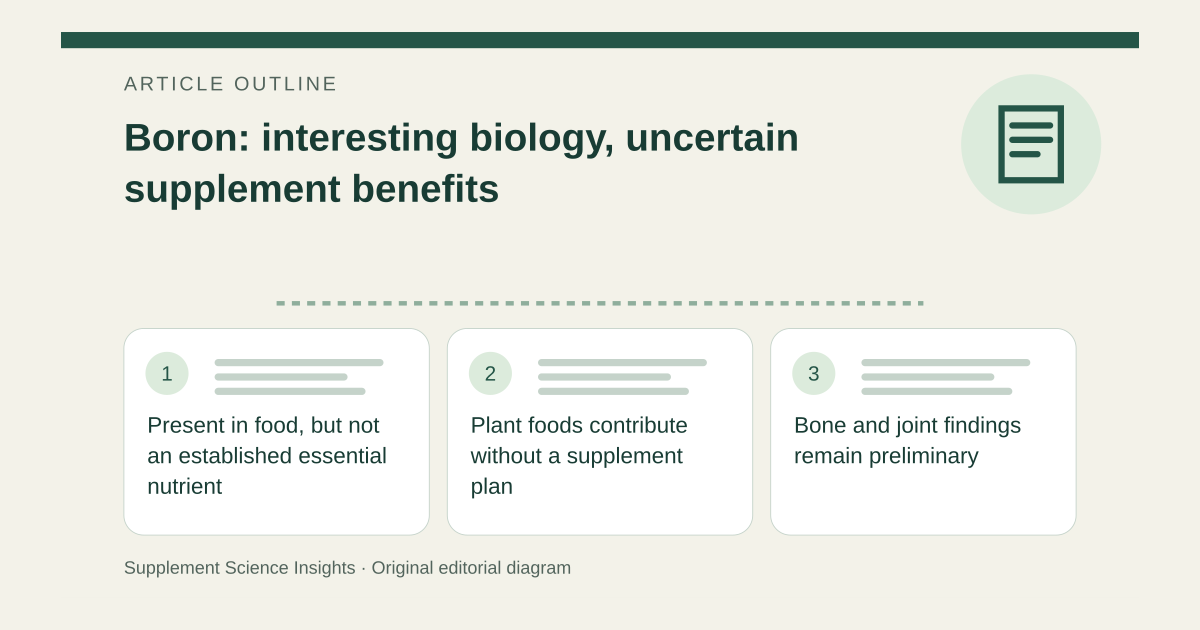
Present in food, but not an established essential nutrient
Boron is a mineral found in many foods, especially plant foods. Scientists have investigated roles in several biological processes, but it is not established as an essential human nutrient. No recommended dietary allowance or adequate intake has been set. [1]
That matters when a product presents a precise dose as if it were filling a recognized daily requirement. A research dose, a typical food intake and an official nutritional requirement are three different kinds of numbers. One cannot silently substitute for another. [1]
Plant foods contribute without a supplement plan
Fruit, legumes, avocados and potatoes can supply boron. NIH estimates that many U.S. adults obtain about 1 mg daily from foods. This describes observed intake; it is not a recommended capsule amount or evidence that everyone needs to increase it. [1]
A varied diet may contain boron alongside fiber, vitamins and other compounds. Benefits associated with that food pattern cannot be assigned to boron alone without a study designed to separate its effect. The same caution applies to an extract containing several ingredients. [1]
Bone and joint findings remain preliminary
Small studies have explored boron preparations for osteoarthritis symptoms and markers related to bone or hormone metabolism. NIH concludes that more research is needed. Evidence about a laboratory marker does not establish fracture prevention, durable pain relief or a useful hormone treatment. [1]
For a joint-health claim, ask whether the outcome was pain during activity, physical function or only an inflammatory marker. For a hormone claim, ask whether a measured change improved symptoms and whether harms were assessed. The name of a mechanism is not enough to answer either question. [1]
A form name is not a clinical ranking
Products may name citrate, glycinate, aspartate or calcium fructoborate. Different preparations need to retain their identities when evidence is discussed. A result for one compound does not automatically establish the same result for every product declaring elemental boron. [1]
The practical comparison therefore starts with a full ingredient name and the declared boron amount. If only a complex weight is provided, a reader cannot infer the elemental amount from the front label. A manufacturer statement can clarify the declaration; it cannot supply a missing clinical trial. [1]
Household borates are not supplements
Borax and boric acid in cleaning products or pesticides should never be treated as dietary substitutes. Excess boron can be toxic. NIH lists an adult upper limit of 20 mg daily from all sources, but a ceiling is not a target and does not establish an effective dose. [1]
Keep the intended route and product category explicit. A household product containing a chemically related substance is not a way to reproduce a supplement study, and an online conversion recipe would not establish safety. [1]
Separate a complex weight from declared boron
Imagine Label A declares “boron 2 mg” and separately identifies its source compound. Label B states only “mineral complex 100 mg.” A provides a boron quantity; B does not, even if boron appears in the ingredient list.
A second serving of A would double its declared boron contribution to 4 mg, but the arithmetic does not establish a reason to use it. Record the purpose and the unresolved evidence alongside the amount. This is a fictional disclosure exercise, not an endorsement of either entry.
| Entry | What is known |
|---|---|
| A: boron 2 mg | Declared elemental amount |
| B: complex 100 mg | Individual boron unresolved |
| Two servings of A | 4 mg; not a recommendation |
Sources for this article
- NIH ODS — Boron, consumer fact sheet
Source consulted: 2026-09-17. This is a reference resource, not a claim that we conducted the studies or tested a product.