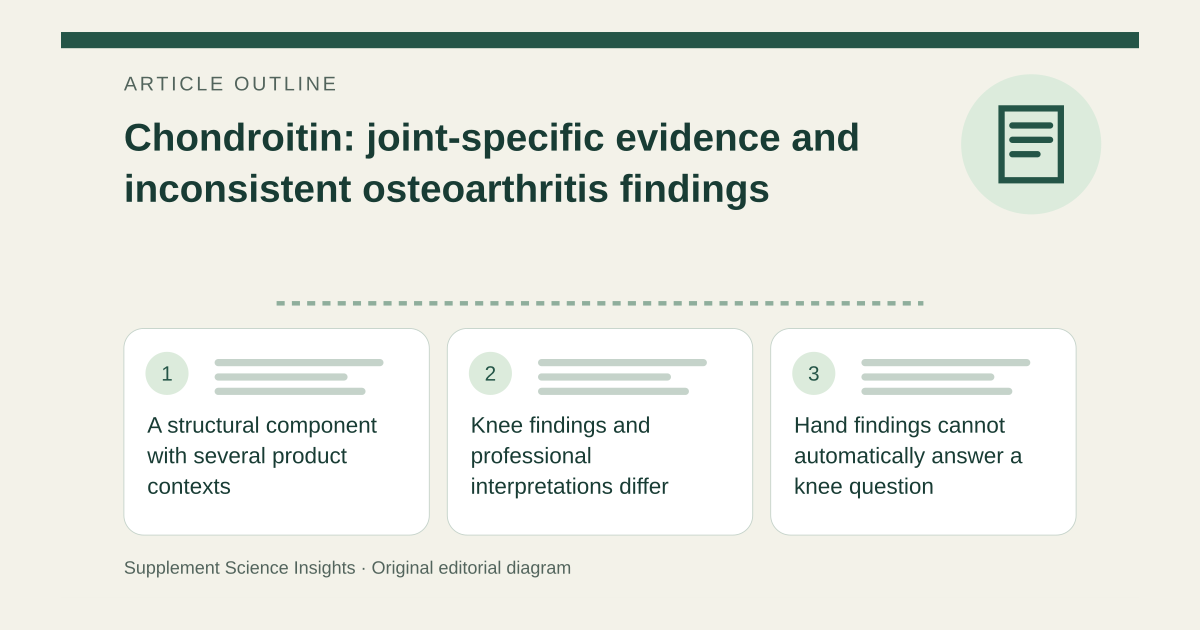
A structural component with several product contexts
Chondroitin is a component of cartilage and is commonly sold as chondroitin sulfate, alone or with glucosamine. Research may involve a particular pharmaceutical preparation or a dietary supplement. Those categories should not be treated as chemically and clinically interchangeable without evidence. [1]
Its role in cartilage helps explain why researchers study it. That role does not prove that swallowing chondroitin restores joint structure or reverses osteoarthritis. Clinical outcomes must be measured rather than inferred from where the substance occurs in the body. [1]
Knee findings and professional interpretations differ
NCCIH describes inconsistent findings for knee pain and function. Some analyses suggest benefit, while differences in study quality and preparation complicate interpretation. Professional recommendations have consequently differed, including distinctions between particular preparations and general supplement use. [1]
This overview does not resolve that disagreement by choosing only favorable studies. A useful account identifies which joint, preparation and outcome were assessed and whether bias or small samples could affect the result. [1]
Hand findings cannot automatically answer a knee question
Evidence in hand osteoarthritis is smaller and has led to a different interpretation in some guidance than the evidence for knees. Other joints have still less research. The anatomical site and functional goal should therefore remain visible. [1]
Structural outcomes are also uncertain. A change in an imaging measurement should not be presented as cartilage regrowth, freedom from pain or avoidance of surgery unless those conclusions were actually demonstrated. Pain, function and joint structure are related but separate endpoints. [1]
Warfarin and combination formulas deserve attention
Large osteoarthritis studies have not identified major general safety problems, but chondroitin has been associated with increased bleeding risk in people taking warfarin. Pregnancy and breastfeeding information is limited. [1]
A formula containing glucosamine or other ingredients adds their own considerations. Record the complete product when reviewing medicines with a clinician or pharmacist. Tolerability is only one part of the decision; it does not resolve inconsistent evidence of benefit or verify the contents of a retail product. [1]
Do not merge pain and function into one claim
Imagine a fictional trial shows a small pain-score difference but no improvement in stair-climbing performance. A precise summary reports those results separately. It should not say that overall joint function improved merely because pain changed.
If the study used chondroitin with glucosamine, the result also belongs to the combination. The example does not identify which ingredient contributed or recommend a treatment.
| Hypothetical outcome | Accurate scope |
|---|---|
| Pain score changed | Symptom result |
| Stair climbing unchanged | No measured functional improvement |
| Combination formula | Individual contribution unresolved |
Use a joint-specific and preparation-specific question
Chondroitin evidence is more nuanced than a cartilage-building story. This page does not recommend a product or promise structural repair. The useful next reading question is whether a defined preparation improved a meaningful outcome in a comparable clinical setting.
Sources for this article
- NCCIH — Glucosamine and chondroitin for osteoarthritis
Source consulted: 2026-09-17. This is a reference resource, not a claim that we conducted the studies or tested a product.