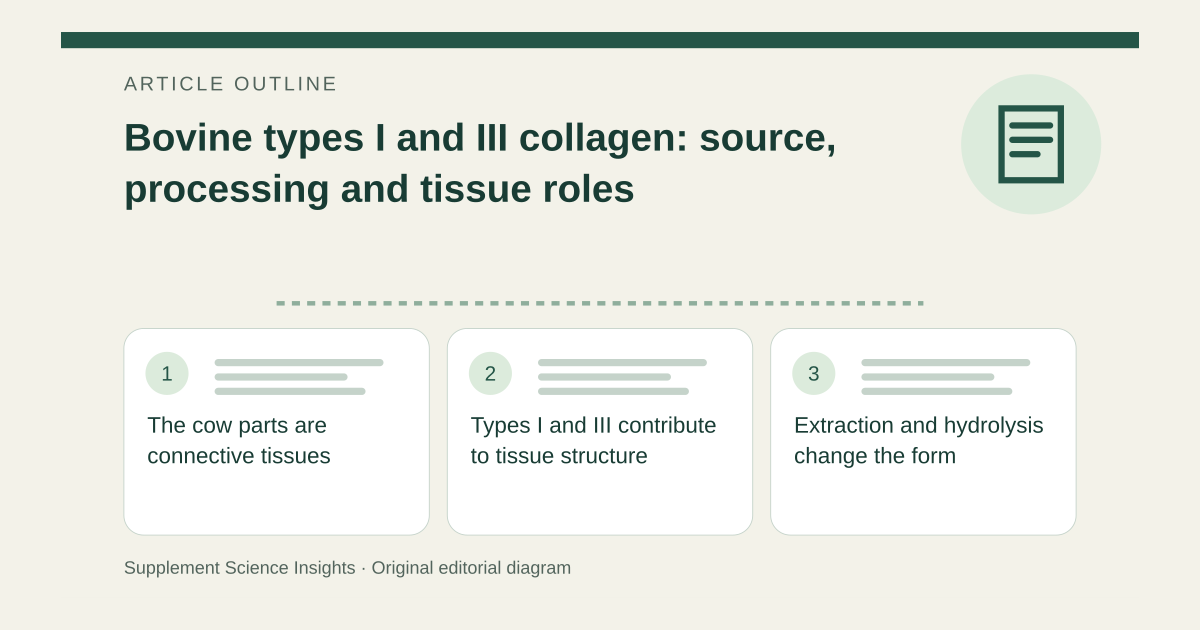
The cow parts are connective tissues
Commercial collagen sources include skin or hides, tendons and bones, with cartilage used for type II products. Bovine identifies cattle as the animal source but does not specify one mandatory cow part. Ask the manufacturer which tissue supplies an individual product when that detail matters to dietary or sourcing requirements. [1]
Types I and III contribute to tissue structure
Type I is abundant in skin, bone and other connective tissues. Type III forms fibrils and occurs in soft connective tissues alongside other matrix components. These proteins function within organized tissue; a list of collagen types is not a map showing where an oral serving will go. [2]
Extraction and hydrolysis change the form
Manufacturing involves extraction and purification, and hydrolysis breaks collagen into smaller peptides. Gelatin, hydrolyzed peptides and native collagen therefore have different structures and properties. The cited manufacturing review has industry affiliations and is used here for terminology, not as independent proof that a retail supplement works. [1]
A source label leaves other questions open
The complete formula, serving amount, contamination controls and evidence for the desired outcome still matter. Bovine does not establish a religious certification, a specific tissue source or a clinical advantage over another preparation. A type I/III claim alone cannot answer those questions. [3][1]
Separate the three label questions
Imagine a container says bovine types I and III collagen peptides. Bovine identifies the animal; I and III refer to collagen types; peptides describes processing. None of those terms alone tells you the size of a skin or joint benefit. [1][2]
| Term | What it describes |
|---|---|
| Bovine | Cattle source |
| Types I and III | Source collagen proteins |
| Hydrolyzed peptides | Processed molecular form |
Sources for this article
- Collagen Supplementation for Joint Health: The Link between Composition and Scientific Knowledge - PMC
Source consulted: 2026-09-21. This is a reference resource, not a claim that we conducted the studies or tested a product. - The Extracellular Matrix of Animals - Molecular Biology of the Cell - NCBI Bookshelf
Source consulted: 2026-09-21. This is a reference resource, not a claim that we conducted the studies or tested a product. - Questions and Answers on Dietary Supplements | FDA
Source consulted: 2026-09-21. This is a reference resource, not a claim that we conducted the studies or tested a product.