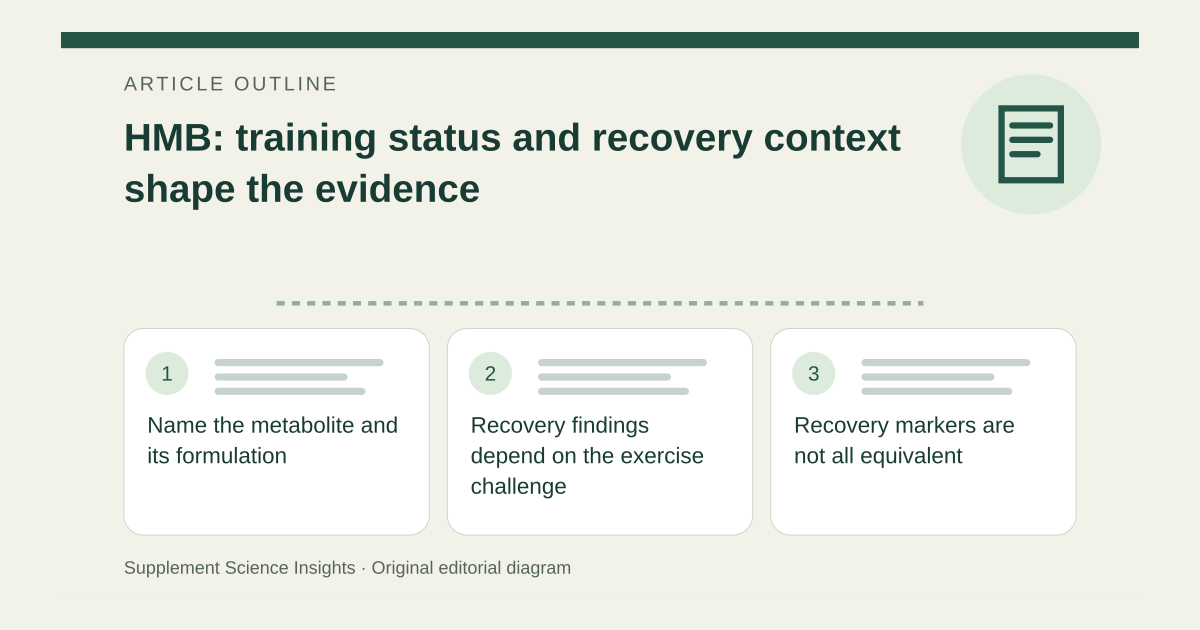
Name the metabolite and its formulation
HMB stands for beta-hydroxy-beta-methylbutyrate, a compound produced from leucine. Supplements may use a calcium-salt form or a free-acid form. These formulations should retain their identity when research is compared. [1]
HMB, leucine and complete protein are related but different interventions. A role in muscle metabolism does not establish that one can replace another, or that a supplement reproduces the broad nutritional contribution of a protein-containing food. [1]
Recovery findings depend on the exercise challenge
NIH ODS describes potential recovery benefits after exercise that causes sufficient muscle damage, alongside mixed findings for other outcomes. Training status matters because a workload that is challenging for an untrained person may be routine for a trained athlete. [1]
Studies differ in age, exercise program, duration and use of other supplements. Those differences limit a single predicted effect for an individual. A favorable result in one demanding protocol does not establish greater muscle growth or performance in every training setting. [1]
Recovery markers are not all equivalent
Soreness, strength restoration, muscle-damage markers and readiness for the next session describe different aspects of recovery. A change in a blood marker does not necessarily mean a person can train better the following day.
For a useful comparison, look for direct functional outcomes and the background protein and energy intake. A blend containing HMB plus other nutrients does not isolate HMB's contribution. Likewise, faster appearance in blood from one form would not by itself prove greater long-term benefit.
Account for the calcium-containing form
Short adult studies have generally found HMB tolerable at the tested amounts. Longer-term use and populations not well represented in those studies require separate consideration. The research should not be generalized automatically to adolescents. [1]
The calcium-salt form contributes calcium, which belongs in a complete intake record if the product declares it. Do not assume that the free-acid and calcium-salt labels have identical additional nutrient content. This page does not provide a loading schedule or a substitute for individualized sports-nutrition advice. [1]
Keep recovery outcomes separate
Imagine a fictional study finds less soreness two days after unfamiliar exercise but no difference in recovered strength. It may support a symptom finding under that protocol, not a demonstrated return of strength.
If the participants were untrained, the finding also leaves questions for an experienced athlete doing a routine session. The example illustrates both outcome and population limits without predicting a particular HMB effect.
| Hypothetical observation | Limit |
|---|---|
| Soreness lower | Symptom result |
| Strength unchanged | No measured strength recovery |
| Untrained participants | Not automatically a trained-athlete result |
A muscle-related pathway is only part of the story
This reference does not recommend HMB for everyone seeking muscle gain. A useful claim identifies the formulation, training status and meaningful recovery endpoint. Nutrition, exercise programming and a defined comparison remain necessary context for interpreting the supplement evidence.
Sources for this article
- NIH ODS — Exercise and athletic performance: professional fact sheet
Source consulted: 2026-09-17. This is a reference resource, not a claim that we conducted the studies or tested a product.