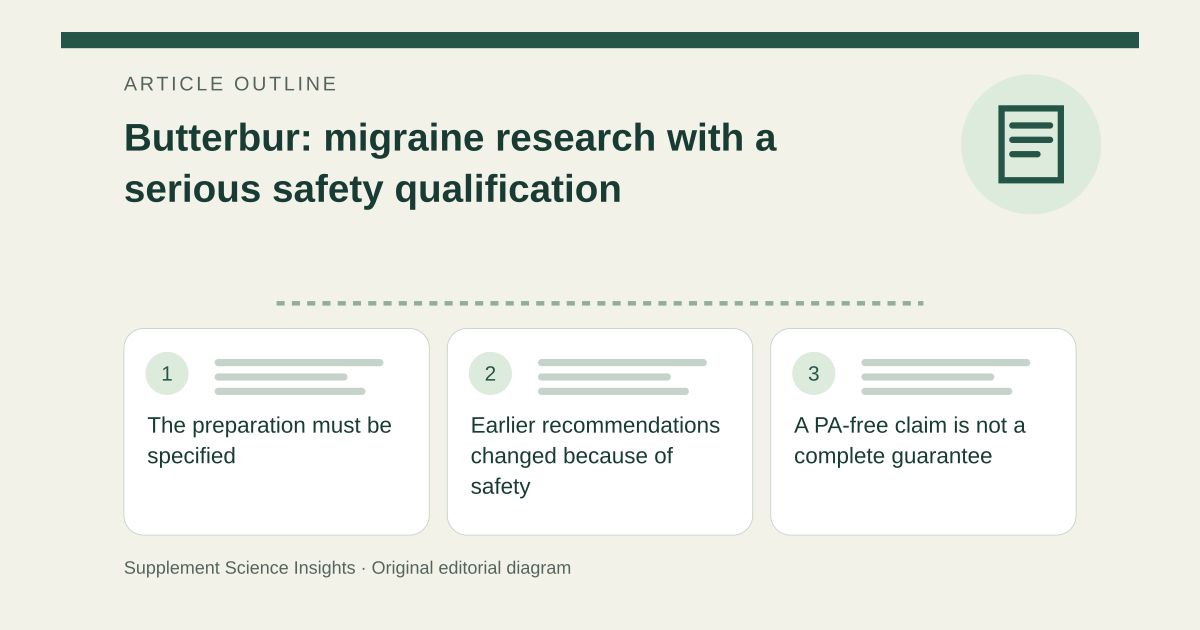
The preparation must be specified
Butterbur, Petasites hybridus, has been studied as root or leaf extracts for migraine prevention and allergic rhinitis. It is not one uniform preparation. The plant can contain pyrrolizidine alkaloids, usually abbreviated PAs, which create a major safety concern. [1]
An ingredient name or a history of herbal use therefore provides too little information for a decision. Processing, analytical verification and the exact intended use matter from the outset. [1]
Earlier recommendations changed because of safety
NCCIH describes evidence that a particular root extract may reduce migraine frequency and that some leaf-extract studies suggest benefit for allergic-rhinitis symptoms. It also notes that the American Academy of Neurology stopped recommending butterbur because of safety concerns. [1]
An older favorable recommendation should not be quoted without that later change. A clinical decision weighs benefit and harm together; a positive efficacy study cannot make a separate toxicity issue disappear. [1]
A PA-free claim is not a complete guarantee
PAs can damage the liver and lungs and may cause cancer. Products containing them should not be treated as acceptable substitutes for preparations processed to remove them. Rare liver-injury reports have also involved products described as PA-free. [1]
That residual uncertainty matters. A front-label claim is not equivalent to independently verified absence of relevant compounds in the actual batch, and even a suitable assay would not establish every aspect of long-term safety. [1]
Allergy and pregnancy add further concerns
Butterbur can cause allergic reactions in people sensitive to related plants such as ragweed. Pregnancy and breastfeeding use is particularly problematic for PA-containing products, while safety of PA-free preparations in those settings is not established. [1]
Migraine prevention also has alternatives that can be assessed with a clinician. The presence of a herbal option is not a reason to bypass diagnosis, medication review or discussion of treatments with clearer safety information. [1]
A safety claim needs a defined test
Imagine a fictional certificate says only “quality tested.” It does not identify a PA assay, detection threshold or product batch. A second certificate names the analytes and batch but has no relationship to the bottle being considered. Neither establishes the needed connection.
The useful record links the actual batch to the specific test and its limitations. This example does not certify any product, establish that testing eliminates all risk or recommend butterbur use.
| Hypothetical document | Missing information |
|---|---|
| Quality tested | Specific PA assay and threshold |
| Unrelated batch certificate | Connection to actual product |
| PA-free statement | Not a complete safety guarantee |
Safety uncertainty is part of the result
A responsible summary can acknowledge migraine findings while concluding that product and liver-safety concerns remain substantial. Do not reduce the evidence to a single positive sentence. This page explains why an older efficacy claim is insufficient for a present-day supplement choice. A preventive migraine claim also differs from a claim to stop an attack already underway; keep that timing explicit.
Sources for this article
- NCCIH — Butterbur: Usefulness and Safety
Source consulted: 2026-09-17. This is a reference resource, not a claim that we conducted the studies or tested a product.