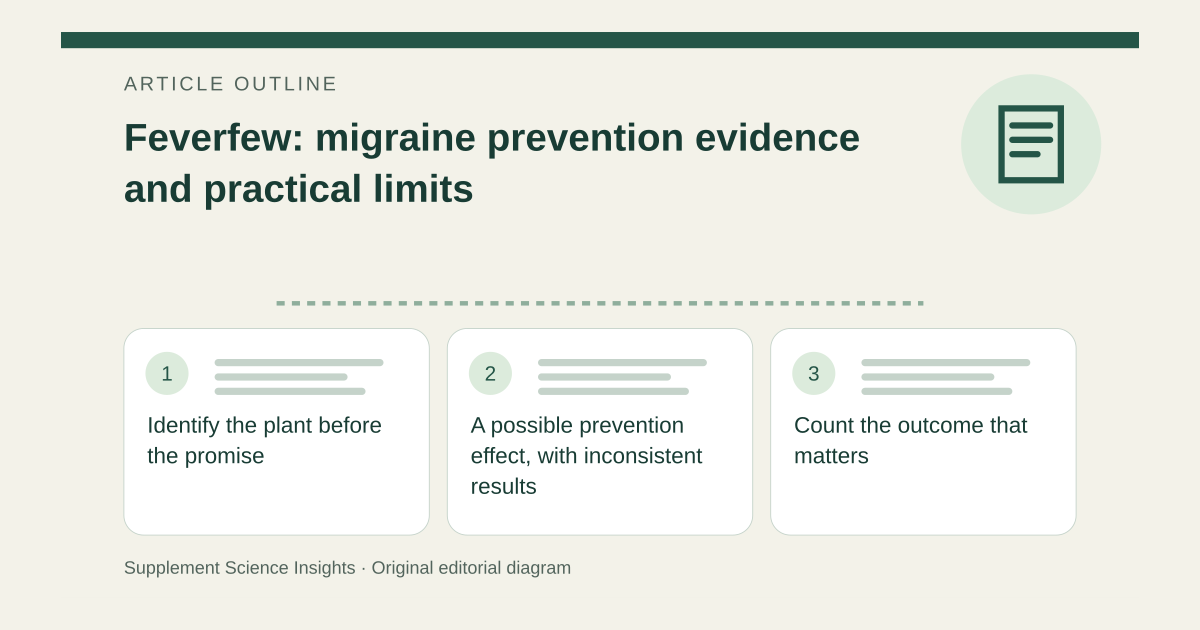
Identify the plant before the promise
Feverfew usually means Tanacetum parthenium, a flowering plant also known by older botanical names. American feverfew is a different plant. A common name on its own therefore leaves room for a mistaken comparison, particularly when several herbs are sold for headaches. [1]
Preparations also vary. Leaves, extracts and products applied to the skin do not represent a single intervention. A study should retain the botanical identity, preparation and route when its results are summarized. [1]
A possible prevention effect, with inconsistent results
NCCIH describes mixed findings for migraine prevention. Some studies suggest fewer headaches or improvement in associated symptoms, but the trials have generally been small and have used different preparations and amounts. That variation limits the confidence of a broad claim about feverfew. [1]
Prevention and acute treatment are separate questions. A trial counting migraine days over several months does not show that taking a product during an attack will stop the attack. Evidence is also insufficient to establish benefit for other promoted uses. [1]
Count the outcome that matters
A headache-frequency result needs a clear denominator: attacks per month, headache days per month and days requiring rescue medication are different measurements. Pain intensity and ability to work may change differently from frequency.
A useful account includes the starting burden, the comparison group and the amount of change. A percentage without those details can make a modest difference sound larger than it is. Recording a headache pattern can help discussion with a clinician, but an uncontrolled diary cannot prove that a supplement caused a change.
Bleeding, allergy and pregnancy change the decision
Feverfew can cause nausea, bloating or other digestive symptoms. Chewing fresh leaves may cause mouth sores or irritation, and related-plant allergies matter. Skin preparations can also cause dermatitis. [1]
It may slow clotting and interact with medicines, including migraine treatments. Tell the surgical team about use well before an operation. It should not be used during pregnancy because of concerns about uterine contractions; breastfeeding information is limited. These cautions apply even when a product is described as traditional. [1]
Distinguish attacks from headache days
Imagine a fictional diary shows four attacks in each of two months, but headache days decrease from eight to six. The number of attacks did not change; their duration or distribution may have changed. Calling this a 25 percent reduction in attacks would be wrong.
The arithmetic describes a two-day reduction in headache days. It neither identifies the cause nor establishes a feverfew effect.
| Fictional measure | Month one | Month two |
|---|---|---|
| Attacks | 4 | 4 |
| Headache days | 8 | 6 |
| Interpretation | Same attack count | Two fewer headache days |
Read prevention claims precisely
Look for the exact preparation, a meaningful migraine outcome and a credible comparison. Keep existing treatment and other changes visible when assessing results. This reference does not offer an acute-treatment protocol or recommend a feverfew product.
Sources for this article
- NCCIH — Feverfew: Usefulness and Safety
Source consulted: 2026-09-17. This is a reference resource, not a claim that we conducted the studies or tested a product.