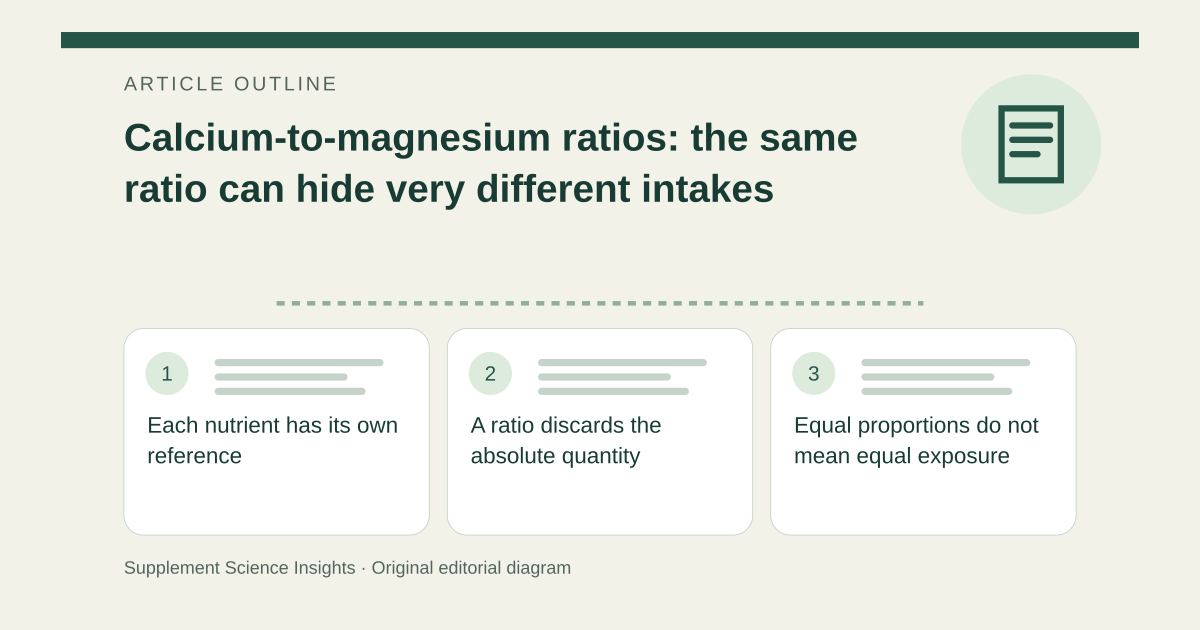
Each nutrient has its own reference
The ODS fact sheets provide separate calcium and magnesium intake references based on age and life stage. These tables do not establish a universal calcium-to-magnesium ratio to use instead of assessing each nutrient. [1][2]
Both minerals participate in normal physiology, but that relationship does not make their dietary needs a simple inverse equation. A change in one label amount does not automatically identify the required change in the other. [1][2]
A ratio discards the absolute quantity
A two-to-one ratio could represent small or very large amounts. It also matters whether a ratio describes one product, all supplements or the entire diet. Those denominators must be kept explicit. [1][2]
The safety references are not interchangeable either: the adult magnesium upper limit concerns supplements and medicines, whereas calcium’s upper limit concerns total intake. A favorable-looking product ratio does not demonstrate that either complete exposure is appropriate. [1][2]
Equal proportions do not mean equal exposure
Imagine fictional products provide calcium and magnesium in amounts of 200 mg and 100 mg, or 2,000 mg and 1,000 mg. Both ratios are two to one, but the second supplies ten times each mineral. These numbers illustrate why a ratio cannot function as a safety assessment or intake plan.
| Detail | Interpretation |
|---|---|
| 200:100 mg | 2:1 ratio |
| 2,000:1,000 mg | Also 2:1 |
| Actual quantities | Tenfold difference |
Sources for this article
- NIH ODS: Calcium
Source consulted: 2026-09-17. This is a reference resource, not a claim that we conducted the studies or tested a product. - NIH ODS: Magnesium
Source consulted: 2026-09-17. This is a reference resource, not a claim that we conducted the studies or tested a product.