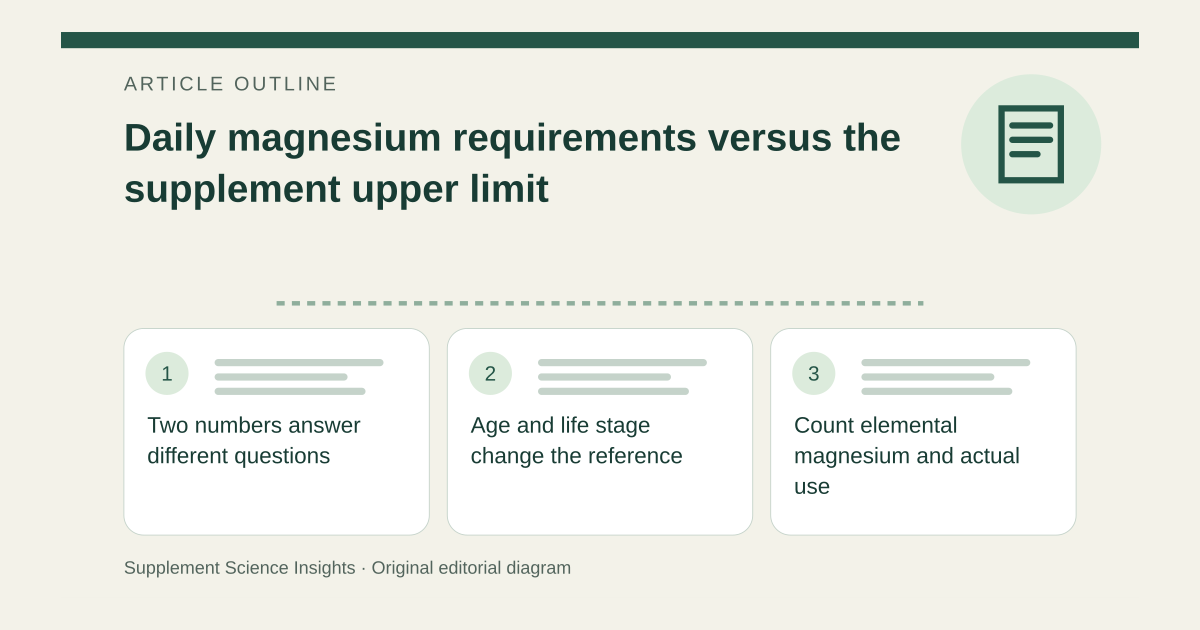
Two numbers answer different questions
The Recommended Dietary Allowance describes total daily magnesium intake sufficient for most healthy people in an age and sex group. The tolerable upper intake level for magnesium applies only to supplements and medicines. NIH ODS explicitly excludes magnesium naturally present in food and beverages from that upper-limit calculation. [1]
The adult supplemental upper limit is 350 mg daily. It is therefore possible for a total-intake requirement to be higher than 350 mg without the two recommendations contradicting each other. [1]
Age and life stage change the reference
For men, the U.S. RDA is 400 mg at ages 19–30 and 420 mg from age 31 onward. For women outside pregnancy, it is 310 mg at ages 19–30 and 320 mg from age 31 onward. Pregnancy has its own age-specific values. [1]
Children also have separate references: for example, the RDA is 80 mg at ages 1–3, 130 mg at ages 4–8 and 240 mg at ages 9–13. Adult supplement limits and serving directions should not be copied to young children. [1]
Count elemental magnesium and actual use
Supplement Facts declares the amount of elemental magnesium rather than the full magnesium-containing compound. The serving size still matters: a per-serving amount may refer to more than one capsule. Count the amount actually used and include magnesium-containing medicines. [1]
Do not add a large compound-weight claim to an elemental amount as though they were the same measurement. A clear source record prevents a misleading total before any safety comparison is made. [1]
A total of 400 mg can have different components
Imagine a hypothetical adult record contains 300 mg from food and 100 mg from supplements. Total intake is 400 mg; the supplemental subtotal is 100 mg. Comparing 400 directly with the 350 mg supplemental limit would mix denominators.
The example is not a recommended menu or proof that this person needs a supplement. It illustrates which sources belong in each sum.
| Observation | Interpretation |
|---|---|
| Food magnesium | 300 mg |
| Supplemental magnesium | 100 mg |
| Total for RDA comparison | 400 mg |
| Subtotal for supplemental UL comparison | 100 mg |
Neither reference replaces an individual clinical plan
The upper limit is not a goal, and staying below it does not guarantee suitability when kidney function or interactions are relevant. Conversely, medical treatment can involve supervised decisions that differ from general nutrition guidance. [1]
Use reference values to understand a record, then review actual need and safety in context. This article does not prescribe a dose for sleep, migraine, cramps or another symptom. [1]
Sources for this article
- NIH ODS — Magnesium: Health Professional Fact Sheet
Source consulted: 2026-09-17. This is a reference resource, not a claim that we conducted the studies or tested a product.