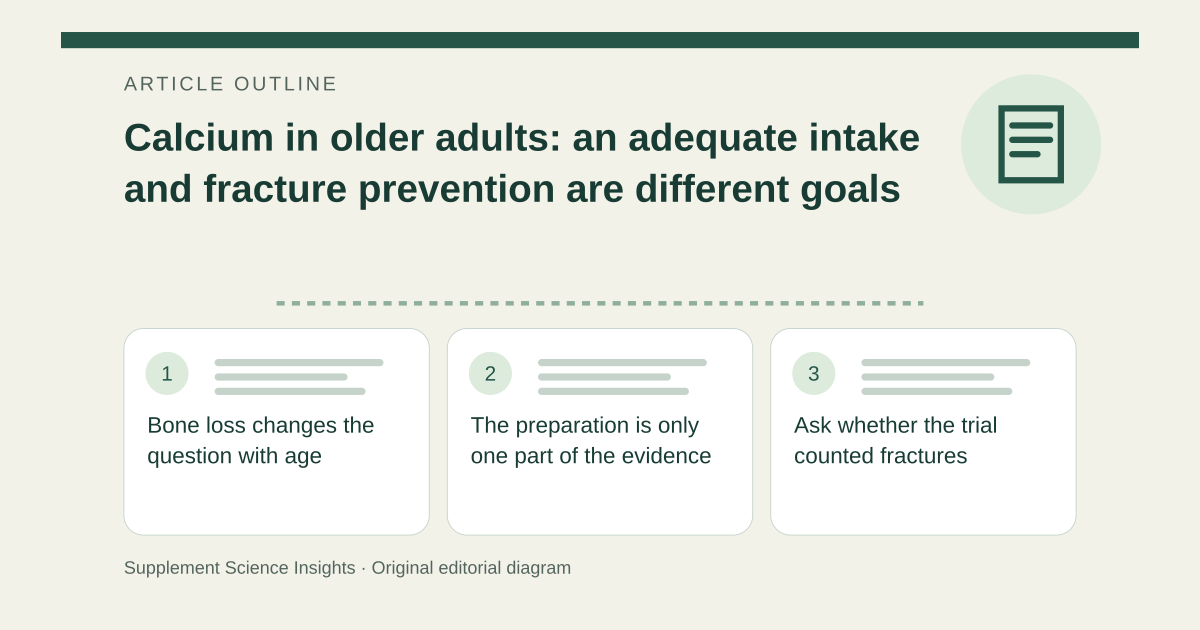
Bone loss changes the question with age
Bone is continually remodeled, and age-related changes can reduce strength in both women and men. Adequate calcium remains part of nutrition, while an osteoporosis diagnosis requires an overall assessment of fracture risk and treatment. [1]
ODS describes mixed evidence for calcium supplements, alone or with vitamin D, in older adults. Some studies improve bone mineral density, but a density change is not automatically a demonstrated reduction in fractures. [1]
The preparation is only one part of the evidence
The ODS synthesis reports positive and negative fracture findings across trials and reviews. Differences in participants, baseline intake, co-supplementation and endpoints limit a simple conclusion that all older adults benefit from the same pill. [1]
Calcium citrate and carbonate differ in dependence on stomach acid and meal context. Those formulation details can help with use, but they do not establish a superior fracture-prevention product. Review food intake, tolerance, medicines and the prescribed bone-health plan before adding calcium. [1]
Ask whether the trial counted fractures
Imagine one preparation improved a bone-density measurement but its study did not demonstrate fewer fractures. Calling it the best fracture-prevention supplement would go beyond the reported result. A useful comparison keeps density, fractures and tolerability in separate columns.
| Detail | Interpretation |
|---|---|
| Density improved | A measured structural outcome |
| Fractures reduced | Needs separate event evidence |
| Product choice | Also depends on individual context |
Sources for this article
- NIH ODS: Calcium
Source consulted: 2026-09-17. This is a reference resource, not a claim that we conducted the studies or tested a product.