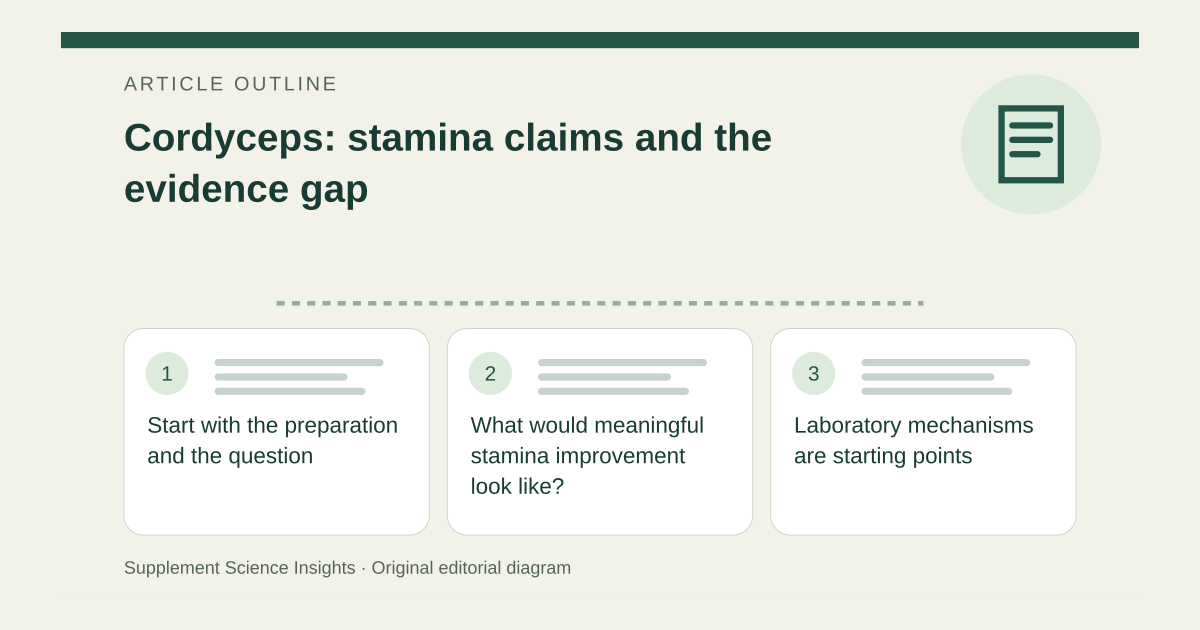
Start with the preparation and the question
Cordyceps is used in traditional Chinese medicine for fatigue and several other purposes. The Memorial Sloan Kettering summary reports mixed exercise findings in healthy people. It also describes kidney research but considers evidence insufficient for certain uses alongside treatment in transplant and dialysis populations. These are separate research questions, not interchangeable reasons to buy a supplement. [1]
What would meaningful stamina improvement look like?
Define the task before judging a claim about energy. Finishing a familiar activity with less difficulty, improving a timed event and changing a laboratory measurement are different outcomes. A study that addresses one cannot automatically answer the others.
For a hypothetical runner comparing two products, the useful question is not which description contains more scientific terms. It is whether a controlled study tested the same preparation, in people with a similar training background, using an outcome relevant to the runner. Without that connection, a performance promise is still missing its most important evidence.
Laboratory mechanisms are starting points
MSK describes laboratory and animal findings involving immune activity, blood sugar and other mechanisms. These observations explain research interest; they do not establish that a retail cordyceps supplement improves health. Its summary also notes that a testosterone finding in mice has not been shown to have the same effect in humans. [1]
Follow the chain from paper to product
Treat the ingredient name as the beginning of a comparison. Look for the exact material described in the paper, how it was prepared and whether other ingredients were included. If those details are unavailable, write down the gap instead of substituting a larger milligram number for an answer.
A blend adds another question: which ingredient, if any, accounts for the reported outcome? A finished-blend trial can support conclusions about that tested blend under its study conditions. It does not isolate cordyceps. Conversely, a study of cordyceps alone does not establish the performance of an unrelated multi-ingredient product.
| Information presented | What it establishes | What remains unanswered |
|---|---|---|
| Laboratory immune finding | A possible mechanism | An exercise benefit in people |
| An exercise study | A result in its tested population | Transfer to a different preparation |
| A multi-ingredient performance blend | Its listed composition | Cordyceps-specific benefit |
Medication and cancer-related cautions
MSK flags possible interactions with glucose-lowering and anticoagulant or antiplatelet medicines, and reports a bleeding case after dental extraction. Some interaction evidence is preclinical, so its frequency in practice remains uncertain. MSK advises against use in myelogenous cancers. Discuss use with the treating team, particularly before procedures or during cancer care. [1]
Sources for this article
- Memorial Sloan Kettering — Cordyceps
Source consulted: 2026-09-17. This is a reference resource, not a claim that we conducted the studies or tested a product.