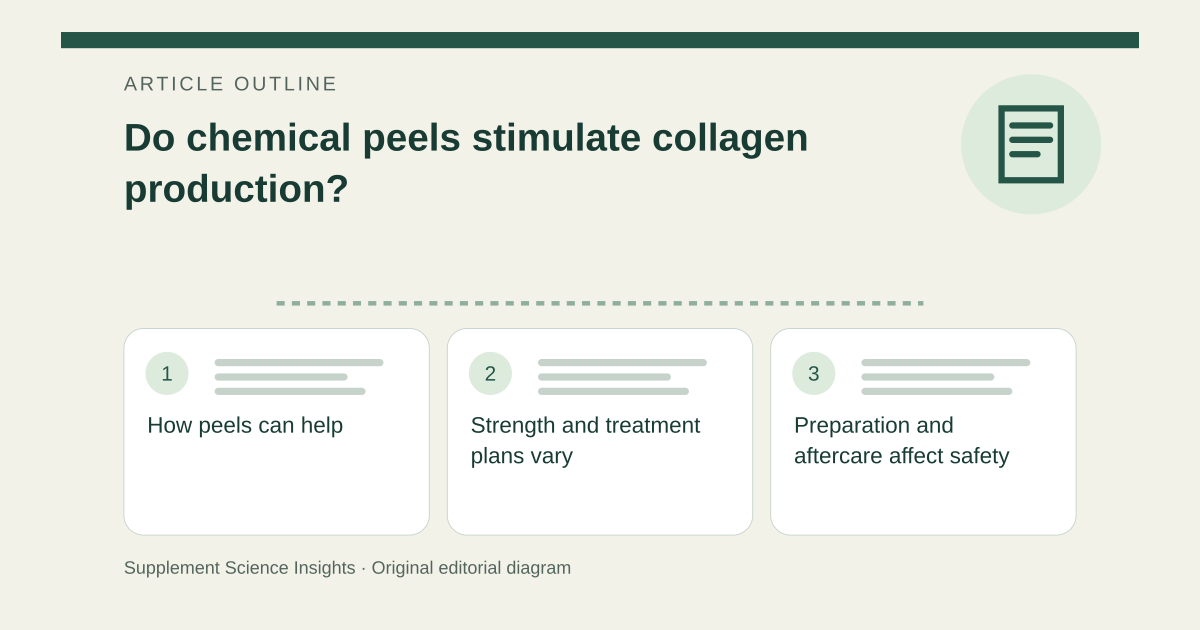
How peels can help
AAD describes collagen and elastin production as part of the response to peels used for depressed acne scars. Peels can also improve fine lines, uneven pigmentation and texture. These are selected indications, not proof that any exfoliating product produces deep remodeling. [1][2]
Strength and treatment plans vary
Peels range in strength, and some require repeated sessions or downtime. A dermatologist selects the approach based on the concern and skin characteristics. A surface-smoothing effect after a mild product should not be equated with the response to a deeper medical procedure. [1][2]
Preparation and aftercare affect safety
AAD advises supervised use because some home peels cause serious injuries. Sun protection and clinician-directed preparation help reduce complications such as discoloration. Increasing acid strength or repeating a peel too soon does not make the outcome more reliable. [2][1]
Choose by indication rather than a collagen slogan
Imagine someone wants to treat depressed acne scars. A dermatologist may discuss a peel alongside other scar treatments and explain likely improvement, recovery and risks. The useful question is whether the selected procedure fits those scars, not simply whether it mentions collagen. [1]
| Claim | Interpretation |
|---|---|
| Acne-scar remodeling | Recognized clinical use |
| Stronger acid | More risk, not guaranteed benefit |
| Home treatment | Requires trained-provider guidance |
Sources for this article
- Acne scars: Consultation and treatment
Source consulted: 2026-09-21. This is a reference resource, not a claim that we conducted the studies or tested a product. - Chemical peels: Overview
Source consulted: 2026-09-21. This is a reference resource, not a claim that we conducted the studies or tested a product.