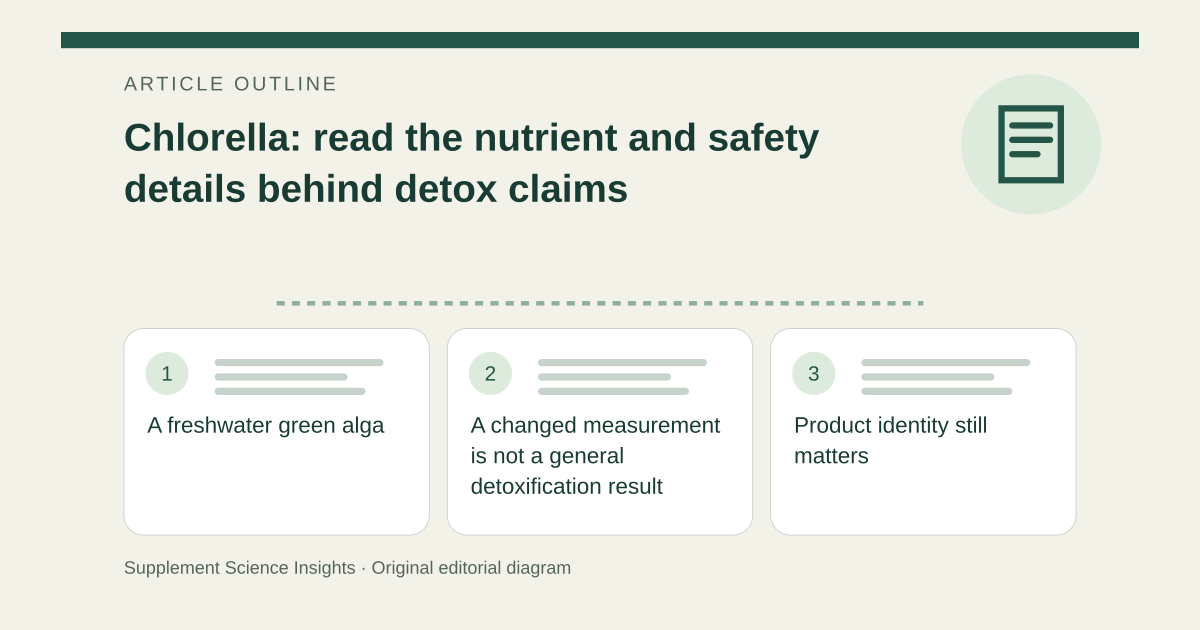
A freshwater green alga
Chlorella is a freshwater green alga containing protein, pigments and a range of nutrients. It is distinct from spirulina, even though both may appear in green powders. A mixture containing both organisms needs to be assessed as a mixture. [1]
The LactMed reference describes chlorella's composition and reports relevant to lactation and safety. That is a defined reference scope, not a comprehensive endorsement of all health claims made for algae supplements. [1]
A changed measurement is not a general detoxification result
LactMed summarizes small studies in which particular chlorella preparations were associated with changes in selected breastmilk constituents. Such findings do not establish that an arbitrary powder improves infant health or removes every substance described as a toxin. [1]
A detox claim needs a named substance, a meaningful exposure or health outcome, an appropriate comparison and a clearly identified preparation. Without those details, the word detox does not describe a testable benefit. Do not convert a specific laboratory measurement into a broad promise about cleansing the body. [1]
Product identity still matters
A study of a named tablet does not establish equivalence to another tablet, a broken-cell-wall powder or a multi-ingredient drink. Compare the amount, formulation and any disclosed composition before deciding whether the reference applies. [1]
Quality testing can help answer questions about identity or contaminants, but a quality mark is not proof of a clinical benefit. Read the scope of the test. Knowing what is in a container and knowing whether it improves an outcome remain separate tasks. [1]
Vitamin K can matter for warfarin
LactMed notes that chlorella's vitamin K content may reduce warfarin's effectiveness. It also describes gastrointestinal symptoms, allergic reactions and photosensitivity reports. Someone taking warfarin should discuss chlorella with the clinician managing anticoagulation rather than making an unmonitored change. [1]
Pregnancy and breastfeeding questions require individual advice. The reference's discussion of likely compatibility in many breastfeeding situations is not proof that every product is appropriate or that supplementation is necessary. [1]
A blend leaves individual amounts unknown
Imagine a hypothetical green supplement provides two grams of a chlorella-and-spirulina mixture per serving, without separate quantities. You cannot assume it provides one gram of each or assign all two grams to chlorella.
You also cannot calculate its vitamin K contribution without composition information. For someone using warfarin, that uncertainty is worth bringing to the treating clinician with the actual label. The calculation should stop where the disclosed data stop; an attractive green color supplies no missing measurement. Keep the product name and serving instructions with the record. That makes a follow-up discussion more useful than a general description of taking greens.
| Hypothetical label | What is known | What is not known |
|---|---|---|
| 2 g algae mixture | Total blend weight | Individual algae amounts |
| No vitamin K figure | No declared quantity | Actual vitamin K exposure |
Sources for this article
- LactMed — Chlorella, revised June 21, 2021
Source consulted: 2026-09-17. This is a reference resource, not a claim that we conducted the studies or tested a product.