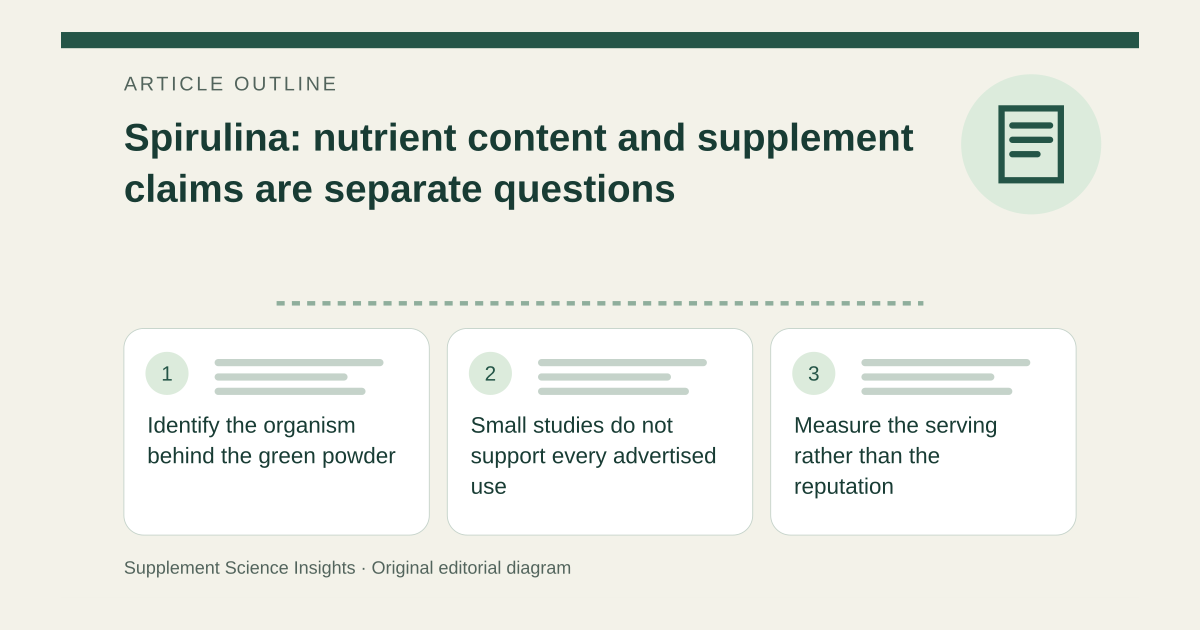
Identify the organism behind the green powder
Spirulina is commonly grouped with blue-green algae, which are cyanobacteria. Products in this category may contain Spirulina species, other organisms or mixtures. Memorial Sloan Kettering's overview distinguishes spirulina from Aphanizomenon flos-aquae, often called AFA. [1]
A broad algae label is therefore insufficient identification. Record the organism and preparation before comparing a powder with research or with another product. [1]
Small studies do not support every advertised use
MSK describes preliminary clinical research for several outcomes, including allergic rhinitis and metabolic measures. Findings in a small, specific patient group do not establish that all spirulina products treat fatigue, improve immunity or prevent serious disease. [1]
Laboratory and animal experiments are especially easy to overstate. An effect on cells or a virus outside a human body does not establish an effective treatment in people. The relevant question is whether a suitable human comparison demonstrated the particular benefit being claimed. [1]
Measure the serving rather than the reputation
A product may be described as rich in nutrients while the suggested serving is small. Evaluate the amounts actually declared per serving, not the composition of a much larger quantity or an impressive percentage without a denominator.
If a nutrient is not quantified, do not assume the supplement meets a nutritional need. Likewise, a protein-containing powder is not automatically comparable with a full protein serving. Use the finished label rather than transferring the nutrient profile of another algae product.
Contamination and allergy deserve attention
MSK warns that blue-green algae products can be contaminated with toxin-producing organisms; associated toxins can cause serious harm. Allergic reactions have also been reported. A natural-source description does not demonstrate purity or suitability. [1]
Ask what a quality test actually measured and whether the report applies to the batch being sold. A test for identity alone is not a test for every contaminant. Discuss use with your clinician when managing a medical condition or taking medicines. [1]
A nutrient percentage needs a serving size
Imagine a hypothetical powder is described as 60% protein by weight and the suggested serving weighs three grams. If that percentage accurately describes the finished powder, the serving supplies 1.8 grams of protein, not 60 grams.
This is an illustrative calculation, not a measured composition claim for spirulina. It shows why a percentage and a serving weight must be read together. Neither the calculation nor a nutrient profile establishes efficacy for a medical condition, verifies the batch's purity or proves that another product has the same composition. If a company provides a test report, match its batch identifier to the container rather than assuming one report covers all products and dates.
| Hypothetical value | Calculation |
|---|---|
| Serving weight | 3 g |
| Protein fraction | 60% |
| Protein per serving | 3 × 0.60 = 1.8 g |
Sources for this article
- Memorial Sloan Kettering — Blue-green Algae
Source consulted: 2026-09-17. This is a reference resource, not a claim that we conducted the studies or tested a product.