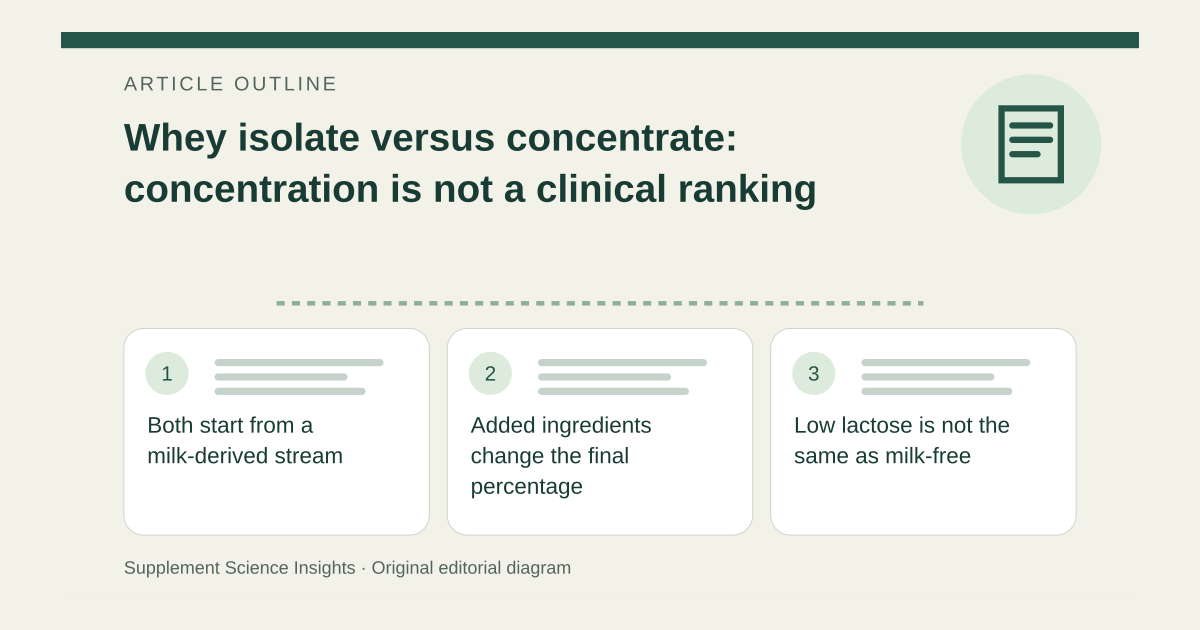
Both start from a milk-derived stream
Whey originates in the liquid separated from curds during cheesemaking. Further processing produces ingredients with different proportions of protein and other milk components. Concentrate and isolate describe that processing and composition distinction. [1][2]
The dairy-industry source describes isolate as roughly 90% or more protein, with most lactose removed. This is an ingredient-level description, not a guarantee about every finished powder containing an isolate. [1][2]
Added ingredients change the final percentage
A flavored blend may include sweeteners, fats, other proteins and additional ingredients. Consequently, the protein fraction of the final scoop may differ from that of the isolate ingredient used to make it. Use the actual protein declaration and serving mass to describe the finished product. [1][2]
A larger protein percentage can be useful when comparing concentration, but it does not establish a greater benefit when total protein intake is already adequate. This source’s manufacturing information is used here without adopting its broader promotional health claims. [1][2]
Low lactose is not the same as milk-free
Isolate can contain less lactose than concentrate, but the exact preparation and serving still matter for tolerance. It remains milk-derived. A lactose-intolerance decision and a milk-allergy decision are therefore different questions. [1][2]
The word isolate also does not establish independent purity testing, absence of every contaminant or suitability for a medical diet. Those require separate evidence. [1][2]
Separate ingredient concentration from scoop composition
Imagine an isolate ingredient is used in a blend that provides 24 g protein in a 30 g serving. The finished blend is 80% protein by the declared amounts. That arithmetic does not contradict a higher protein percentage for the isolated ingredient before blending.
| Question | Relevant distinction |
|---|---|
| Isolate ingredient | Higher protein fraction |
| Finished blend | May include other ingredients |
| 80% in the example | 24 ÷ 30 × 100 |
Sources for this article
- U.S. Dairy: What is Whey Protein?
Source consulted: 2026-09-17. This is a reference resource, not a claim that we conducted the studies or tested a product. - NIDDK: Eating, Diet, and Nutrition for Lactose Intolerance
Source consulted: 2026-09-17. This is a reference resource, not a claim that we conducted the studies or tested a product.