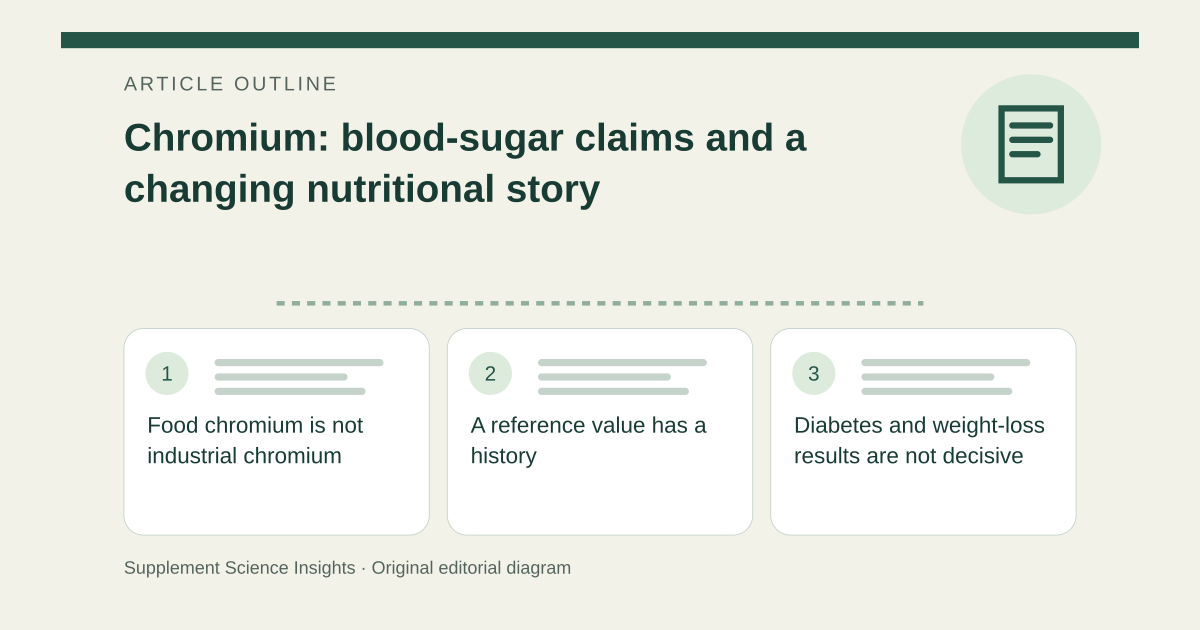
Food chromium is not industrial chromium
The chromium discussed in nutrition is chromium(III), or trivalent chromium. It differs from hexavalent chromium, a toxic industrial form. Confusing the two can produce both exaggerated reassurance and exaggerated alarm. [2]
Chromium's status as an essential nutrient has also been reconsidered. NIH explains that older U.S. intake values were set when essentiality was assumed; current evidence does not establish that chromium is necessary for good health in the same way as well-defined essential minerals. [2]
A reference value has a history
Foods including meats, grains, vegetables and fruits contain chromium, with variable amounts. The familiar U.S. values of 35 mcg for men and 25 mcg for women aged 19–50 date to the 2001 assessment. They should not be presented as newly proven supplemental requirements. [2]
A label's percentage of Daily Value is a labeling tool, not evidence that the user is deficient. The historical basis matters particularly when a sales claim describes a large multiple of that value as an “optimal” intake. [2]
Diabetes and weight-loss results are not decisive
NIH summarizes mixed results for blood-glucose control and no clear basis for routine chromium supplementation in diabetes. Studies of weight or body composition do not establish a substantial, reliable weight-loss effect. Trial preparations and participant characteristics vary. [1]
A small change in a laboratory marker is not the same as fewer complications, less medication or sustained weight loss. A useful comparison keeps the actual outcome and background treatment attached to the finding rather than relabeling any favorable number as metabolic improvement. [1]
Medicine interactions deserve attention
Chromium may add to the glucose-lowering effects of insulin or other diabetes medicines, increasing hypoglycemia risk. Chromium picolinate taken with levothyroxine can reduce absorption of that medicine. People with kidney or liver disease also warrant particular caution. [1]
No upper intake limit has been established because safety data are insufficient. That absence does not authorize unrestricted dosing. Bring the exact preparation and serving amount to a pharmacist or clinician rather than relying on the general description “trace mineral.” [1]
Separate the mineral from its compound
Imagine a label says “chromium 200 mcg, as chromium picolinate.” The declared chromium quantity is 200 mcg. A separate statement about the mass of the picolinate compound should not replace that nutrient entry.
A second fictional product declares 100 mcg per capsule and defines two capsules as a serving. Its serving provides 200 mcg by the label. Equal declared chromium amounts do not prove equal manufacturing quality, absorption or effects on blood glucose.
| Label | Chromium per serving |
|---|---|
| A: nutrient row | 200 mcg |
| B: 100 mcg per capsule, two capsules | 200 mcg |
| Compound mass alone | Not the nutrient declaration |
A familiar supplement claim can outlive its evidence
A careful decision asks whether supplementation has a demonstrated purpose, not simply whether chromium appears on a nutrient panel. In particular, do not use a chromium product as a reason to stop or reduce prescribed diabetes treatment.
This page draws on NIH reference summaries and records the uncertainty explicitly. It does not rank products, infer deficiency from cravings or prescribe a dosing interval around thyroid medication. Those questions require the actual clinical context.
Sources for this article
- NIH ODS — Chromium, professional fact sheet
Source consulted: 2026-09-17. This is a reference resource, not a claim that we conducted the studies or tested a product. - NIH ODS — Chromium, consumer fact sheet
Source consulted: 2026-09-17. This is a reference resource, not a claim that we conducted the studies or tested a product.