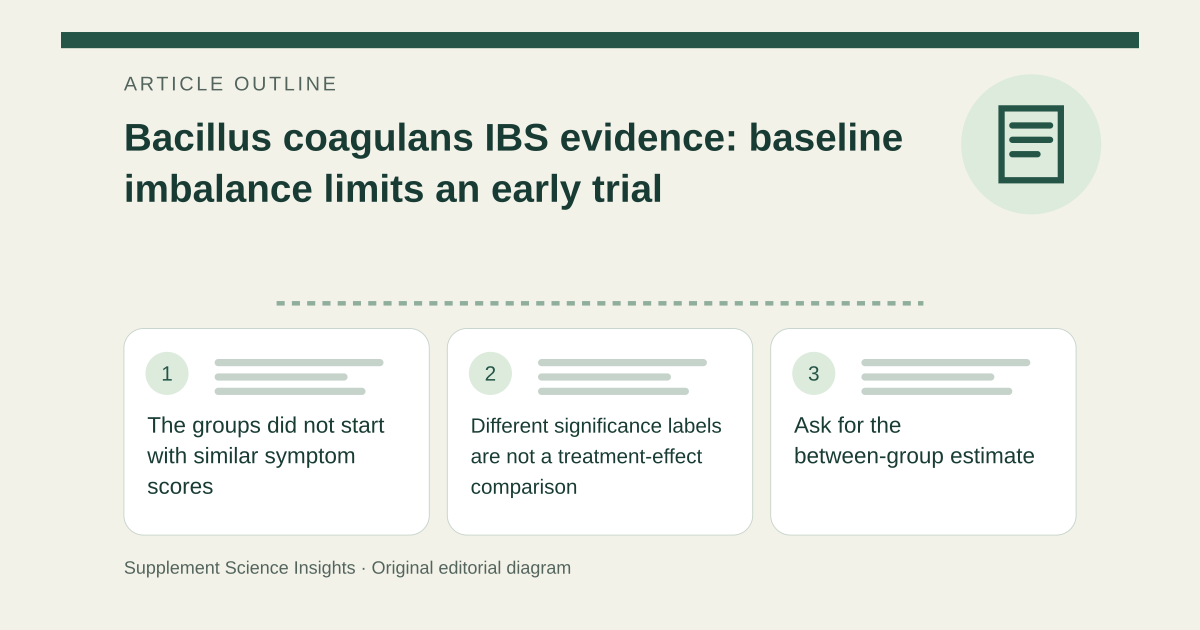
The groups did not start with similar symptom scores
The double-blind, placebo-controlled study enrolled 44 people with IBS for eight weeks. Participants recorded abdominal pain and bloating daily. [1]
Because the groups differed significantly at baseline, the report used within-group analyses. The probiotic group improved relative to its own starting scores, while fewer weekly placebo comparisons reached statistical significance. [1]
Different significance labels are not a treatment-effect comparison
A significant change in one group and a nonsignificant change in another do not by themselves establish a significant difference between the groups. Starting imbalance and regression toward typical values can complicate before-and-after changes. [1]
The authors called the findings preliminary and requested larger, longer studies. No treatment-related or serious adverse events were reported in this short trial, but that small safety observation cannot establish safety for every user. Funding and conflicts were not fully assessed from the abstract. [1]
Ask for the between-group estimate
Imagine one group’s score improves with a p-value below 0.05 and the other group’s does not. A direct comparison of the changes is still needed before concluding that the treatments differ.
| Detail | Interpretation |
|---|---|
| 44 participants | Small study |
| Baseline imbalance | Complicates interpretation |
| Within-group improvement | Not sufficient comparative proof |
Sources for this article
- Bacillus coagulans significantly improved abdominal pain and bloating in patients with IBS - PubMed
Source consulted: 2026-09-19. This is a reference resource, not a claim that we conducted the studies or tested a product.