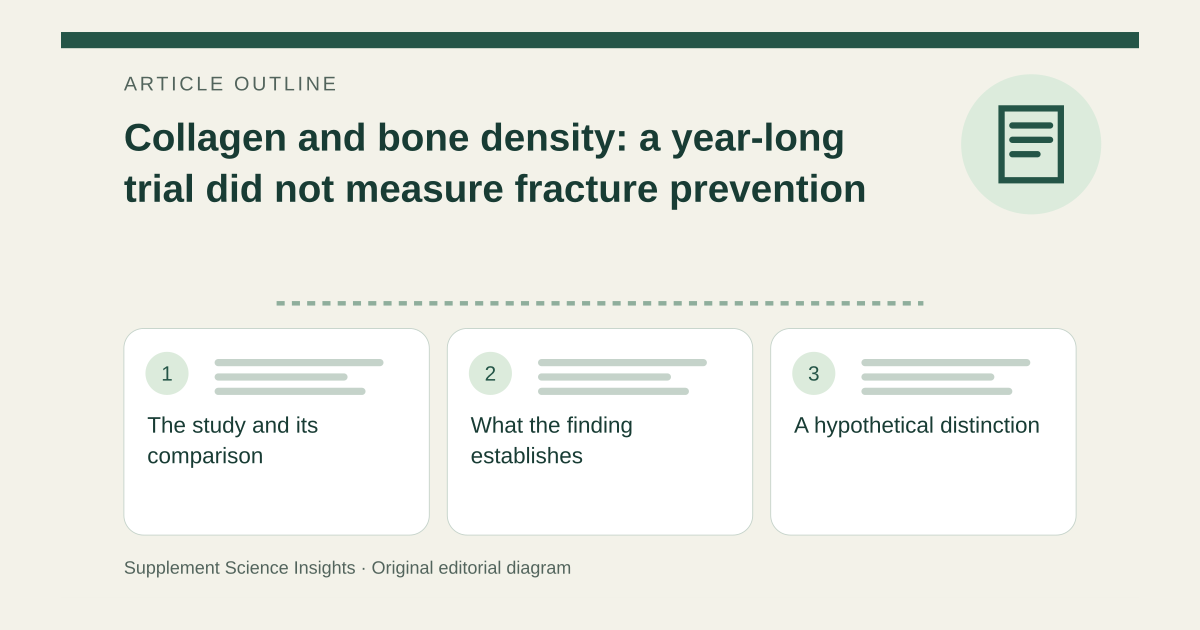
The study and its comparison
Researchers enrolled 131 postmenopausal women with reduced bone mineral density. Participants received 5 grams daily of specific collagen peptides or placebo for 12 months; 102 completed follow-up, with all enrolled participants included in the intention-to-treat analysis. [1]
Spine and femoral-neck density changes favored the collagen group. Bone-turnover markers also changed, but fractures were not the primary outcome. [1]
What the finding establishes
The study does not rank retail products or establish that collagen replaces osteoporosis treatment. GELITA partly funded the work; the authors reported independent study management and no conflicts. The selected population, incomplete follow-up and preparation-specific result remain relevant when applying the findings. [1]
A hypothetical distinction
Imagine density improves without fracture events being studied. A fracture-prevention promise would require additional evidence.
| Detail | Interpretation |
|---|---|
| Measured outcome | Keep the endpoint specific |
| Study preparation | Not every retail product |
| Remaining uncertainty | Not resolved by a mechanism |
Sources for this article
- Specific Collagen Peptides Improve Bone Mineral Density and Bone Markers in Postmenopausal Women—A Randomized Controlled Study - PMC
Source consulted: 2026-09-19. This is a reference resource, not a claim that we conducted the studies or tested a product.