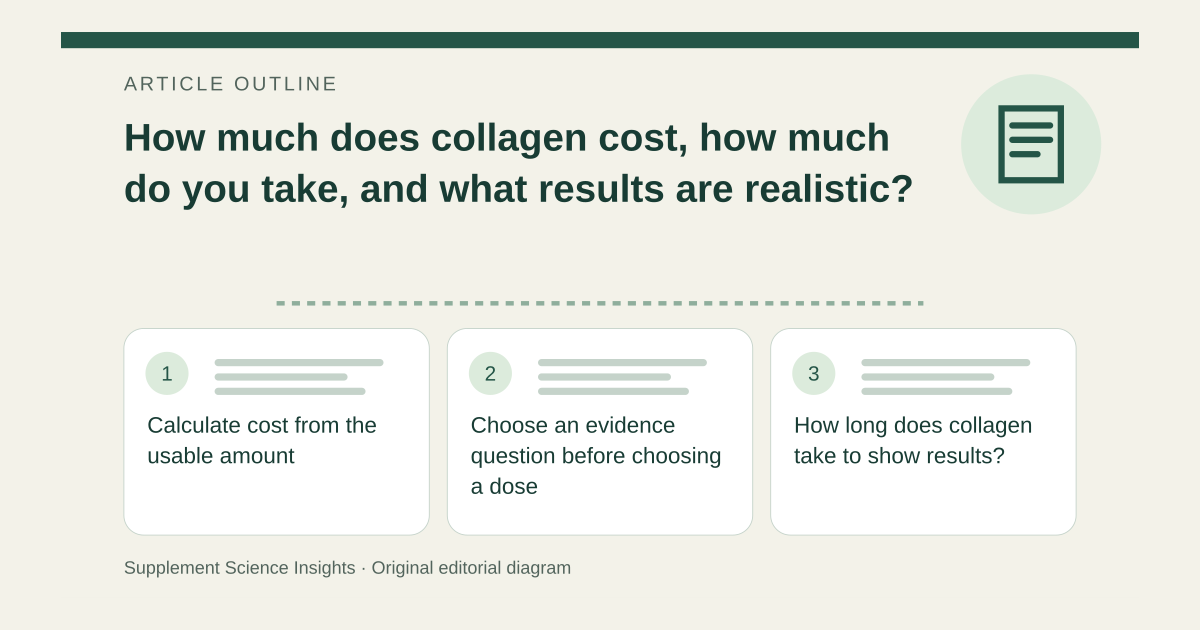
Calculate cost from the usable amount
Read the net quantity and collagen amount per serving, distinguishing pure collagen from a blend containing other ingredients. Divide price by the number of servings at the amount being compared. Include subscription conditions and shipping when relevant. Current retail prices vary, so an example calculation is more useful than an undated universal price. [1]
Choose an evidence question before choosing a dose
Collagen studies vary in formulation, duration, population and endpoint. A skin-hydration study cannot establish a joint-treatment dose, and the 2025 skin meta-analysis found results sensitive to study quality and funding. Follow the product instructions and clinical advice where relevant; there is no guarantee that more collagen produces a larger benefit. [2][3]
How long does collagen take to show results?
Think in terms of the specific outcome and study follow-up, not a guaranteed onset date. One trial of a particular collagen-peptide preparation assessed eye wrinkles over eight weeks. A different trial of undenatured type II collagen in knee osteoarthritis used a 180-day primary assessment. These preparations, populations and endpoints are not interchangeable. [4][5]
The knee trial was industry-funded, and neither trial establishes that any collagen powder will produce the same result. A study’s assessment date is not the first day a person will notice a benefit. Decide in advance what change would be meaningful and review continuing cost against actual benefit; do not buy an indefinite supply on the assumption that more time guarantees a response. [4][5]
An independently listed collagen example
A directory check on September 25, 2026 found Momentous Collagen Peptides in NSF Certified for Sport: unflavored powder, 507 g package, 16.9 g serving; the listing reports All in its lot field. This is an independently listed quality-check example, not a clinical winner. It does not certify another brand, a different pack or flavor, or an Amazon seller. Recheck the exact entry and your lot before purchase. [6][7]
Compare a hypothetical purchase consistently
Imagine a pure 300 g powder costs $30. Comparing at 10 g per serving gives 30 servings and $1 per serving. A pure 450 g powder at $36 gives 45 such servings and $0.80 each. Those numbers are hypothetical, and 10 g is a comparison amount, not a personal recommendation. Neither calculation proves that either powder works. [1]
| Observation | What it does not establish |
|---|---|
| A generic amount or average | An individual prescription or quote |
| A related product or study | The same intervention |
| A plausible mechanism | A guaranteed result |
Sources for this article
- Questions and Answers on Dietary Supplements | FDA
Source consulted: 2026-09-21. This is a reference resource, not a claim that we conducted the studies or tested a product. - Effects of Collagen Supplements on Skin Aging: A Systematic Review and Meta-Analysis of Randomized Controlled Trials.
Source consulted: 2026-09-21. This is a reference resource, not a claim that we conducted the studies or tested a product. - Collagen Supplementation for Skin and Musculoskeletal Health: An Umbrella Review of Meta-Analyses on Elasticity, Hydration, and Structural Outcomes.
Source consulted: 2026-09-21. This is a reference resource, not a claim that we conducted the studies or tested a product. - Proksch et al. 2014: specific collagen peptides and skin wrinkles, PMID 24401291
Source consulted: 2026-09-25. This is a reference resource, not a claim that we conducted the studies or tested a product. - Lugo et al. 2016: undenatured type II collagen in knee osteoarthritis
Source consulted: 2026-09-25. This is a reference resource, not a claim that we conducted the studies or tested a product. - NSF Certified for Sport directory: Momentous Collagen Peptides
Source consulted: 2026-09-25. This is a reference resource, not a claim that we conducted the studies or tested a product. - NSF Certified for Sport: what the mark means
Source consulted: 2026-09-25. This is a reference resource, not a claim that we conducted the studies or tested a product.