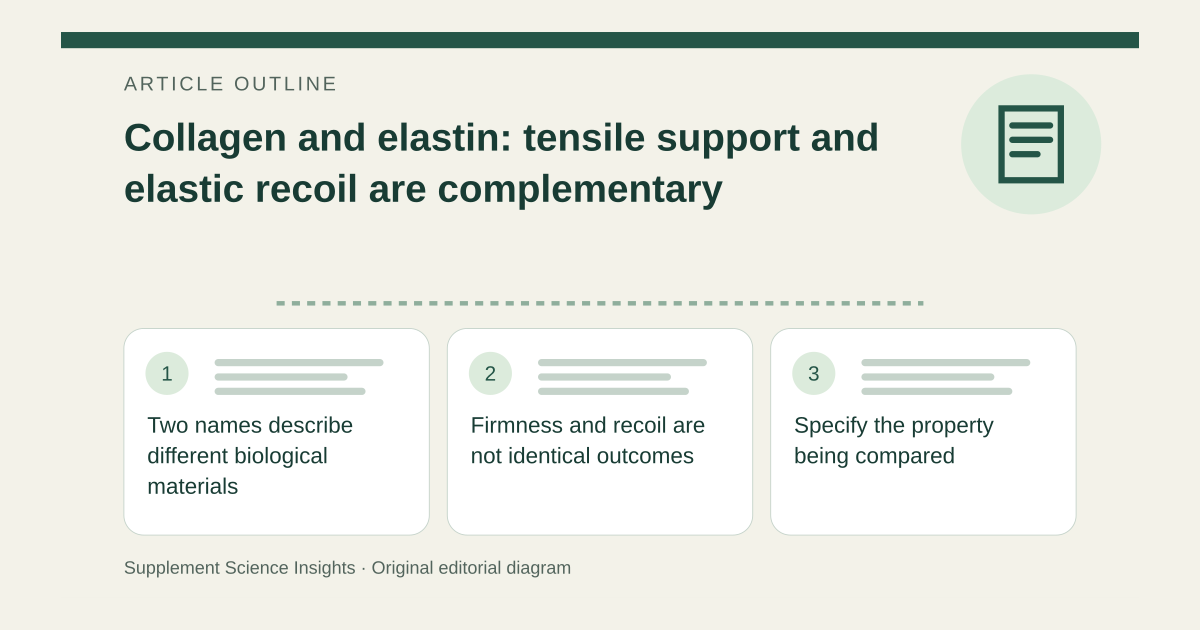
Two names describe different biological materials
Collagen forms structures that support connective tissues, including strong type I fibers. Elastin is produced from tropoelastin, encoded by the ELN gene, and is a major component of elastic fibers. It is not simply another name for collagen. [1][2]
MedlinePlus describes elastic fibers as able to stretch and recoil, contributing resilience in tissues such as skin, lungs and blood vessels. A tissue’s behavior depends on the coordinated organization of its components rather than a single protein label. [1][2]
Firmness and recoil are not identical outcomes
A change in one mechanical or cosmetic measure does not automatically establish a change in another. Descriptions such as support, elasticity and firmness need to be tied to what was actually measured rather than used as synonyms. [1][2]
A product containing collagen does not thereby contain elastin, and neither name proves that an oral preparation changes the corresponding tissue network. The genetic and structural sources cited here explain normal biology; they are not trials of oral or topical products. [1][2]
Specify the property being compared
Imagine a material resists stretching but returns poorly after being stretched, while another recoils readily. A single word such as strong would hide the difference. A meaningful comparison identifies both the loading response and the recovery behavior.
| Level or observation | Meaning |
|---|---|
| Collagen fiber support | Resistance and structural organization |
| Elastic-fiber recoil | Recovery after stretch |
| A product benefit | Requires its own measured outcome |
Sources for this article
- MedlinePlus Genetics: COL1A1
Source consulted: 2026-09-17. This is a reference resource, not a claim that we conducted the studies or tested a product. - MedlinePlus Genetics: ELN
Source consulted: 2026-09-17. This is a reference resource, not a claim that we conducted the studies or tested a product.