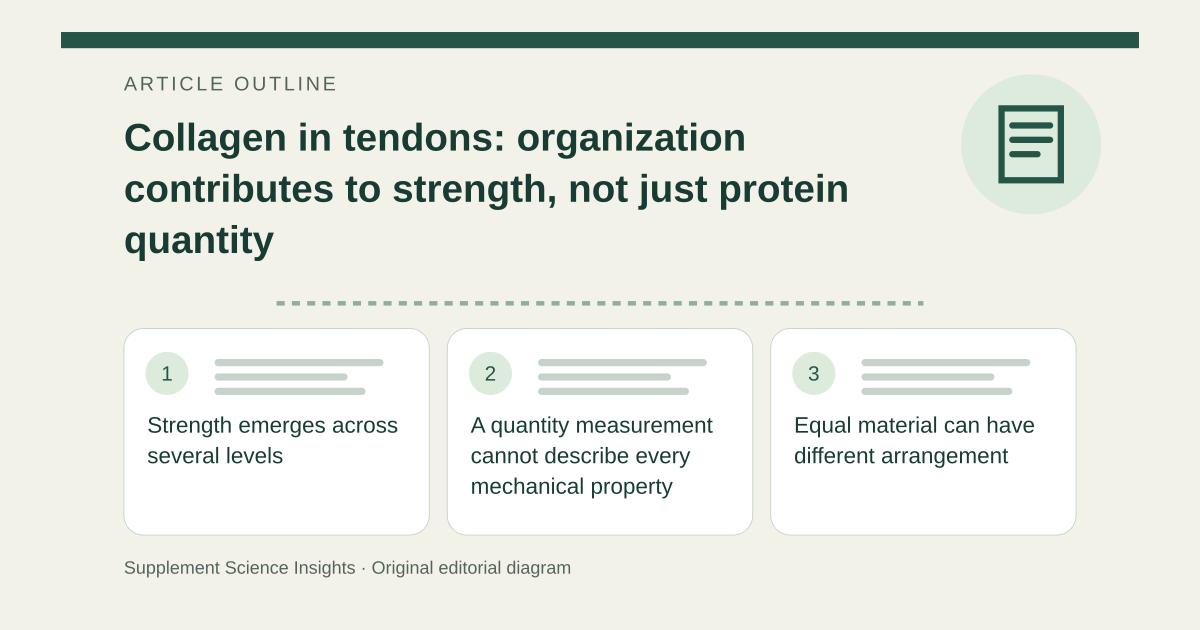
Strength emerges across several levels
Type I collagen is important in tendons. MedlinePlus describes its molecules assembling into fibrils with stable cross-links, producing strong fibers. This is a hierarchy: individual chains form molecules, and many molecules participate in larger assemblies. [1][2]
The extracellular-matrix textbook describes cells mechanically organizing collagen they secrete. In laboratory systems, fibroblasts can draw a collagen network into aligned structures. These observations explain why tissue architecture is an active biological process, not simply a pile of protein. [1][2]
A quantity measurement cannot describe every mechanical property
A measure of total collagen does not specify fiber orientation, cross-linking or how the tissue is organized. A claim that more collagen necessarily means a stronger tendon skips those additional variables. [1][2]
This structural account does not establish that an oral collagen supplement prevents tendon injury or treats tendinopathy. Nor does a cell-culture observation prescribe an exercise or rehabilitation load. Those clinical questions require studies of the intervention and the relevant functional outcome. [1][2]
Equal material can have different arrangement
Imagine two bundles contain the same number of cords, but one is aligned with the direction of pull and the other is disorganized. Their shared material count does not establish identical behavior. This analogy illustrates organization; it is not a model that predicts a human tendon’s strength.
| Level or observation | Meaning |
|---|---|
| Collagen amount | One material property |
| Alignment and cross-links | Additional organization |
| Tendon function | Requires tissue-level assessment |
Sources for this article
- MedlinePlus Genetics: COL1A1
Source consulted: 2026-09-17. This is a reference resource, not a claim that we conducted the studies or tested a product. - Molecular Biology of the Cell, 4th edition: The Extracellular Matrix of Animals
Source consulted: 2026-09-17. This is a reference resource, not a claim that we conducted the studies or tested a product.