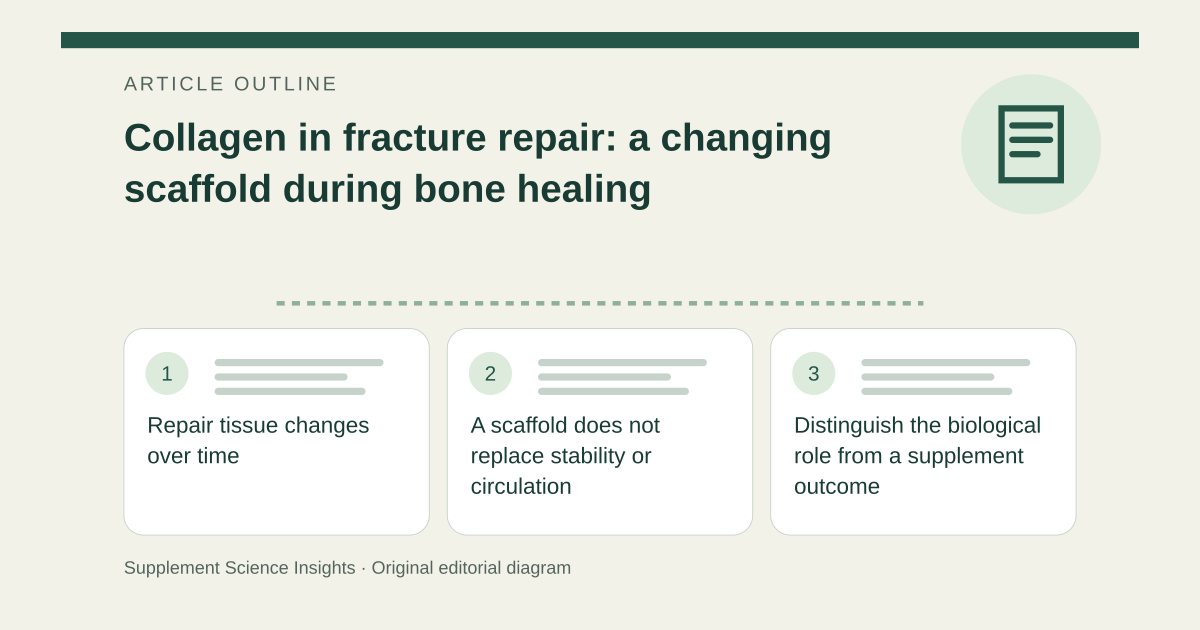
Repair tissue changes over time
In the common callus-forming pathway, early repair tissue develops into a cartilage-containing soft callus and then bone. Collagen deposition and organization change as the tissue matures. Type I collagen becomes prominent in mature bone, where the organic framework works with mineral rather than acting alone. [1]
A scaffold does not replace stability or circulation
The review describes how vascular supply, motion and the local mechanical environment influence repair. An unstable fracture is not simply missing a nutritional building block. Treatment aims to provide conditions in which cells can build, mineralize and remodel tissue appropriately. [1]
Distinguish the biological role from a supplement outcome
Imagine a collagen advertisement points out that healing bone contains collagen. That is a description of biology, not a clinical trial showing that the powder accelerates union or replaces fracture treatment. Follow the orthopedic plan and discuss nutritional concerns within it; the repair mechanism cannot establish an effective supplement dose. [1][2]
| Observation | Interpretation |
|---|---|
| Collagen in repair tissue | A normal biological component |
| Stable, vascular repair environment | Part of the healing process |
| Faster healing from a powder | Requires direct clinical evidence |
Sources for this article
- Basic concepts regarding fracture healing and the current options and future directions in managing bone fractures - PMC
Source consulted: 2026-09-20. This is a reference resource, not a claim that we conducted the studies or tested a product. - Dietary Supplements: What You Need to Know
Source consulted: 2026-09-20. This is a reference resource, not a claim that we conducted the studies or tested a product.