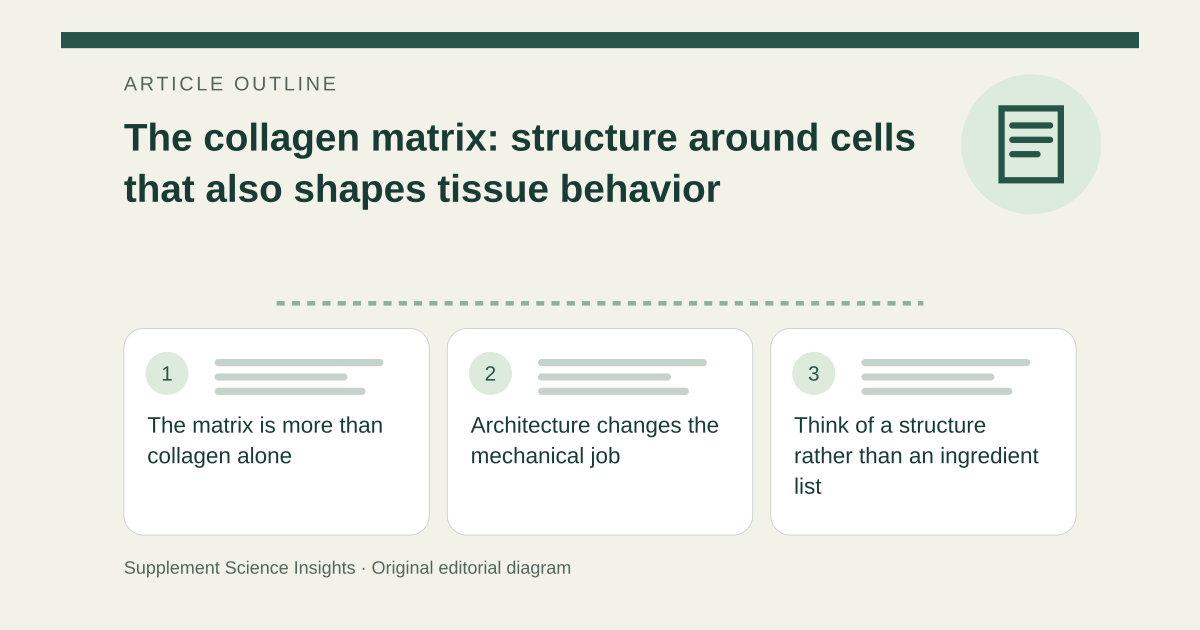
The matrix is more than collagen alone
The extracellular matrix includes fibrous proteins and carbohydrate-rich molecules such as proteoglycans. Collagen contributes resistance to pulling forces; other components influence hydration, elasticity and connections between cells and their surroundings. Calling the matrix a collagen scaffold is useful shorthand, but it leaves out much of the system. [1]
Architecture changes the mechanical job
Cells both make and organize their surrounding matrix. Closely aligned collagen can support a strong pull in a preferred direction, while different arrangements suit other tissues. Collagen quantity alone therefore does not explain tissue behavior: orientation, associated molecules and organization across scales also matter. [1]
Think of a structure rather than an ingredient list
Imagine two tissues contain collagen but need different mechanical properties. A tendon transmits force along its length; another tissue needs a different spatial arrangement. Knowing both contain collagen does not make them mechanically identical, and consuming a protein does not specify how cells will assemble a local matrix. [1]
| Observation | Interpretation |
|---|---|
| Same protein family | Can have different tissue organization |
| More collagen | Not a complete measure of function |
| Cells and matrix | Influence each other |
Sources for this article
- The Extracellular Matrix of Animals - Molecular Biology of the Cell - NCBI Bookshelf
Source consulted: 2026-09-20. This is a reference resource, not a claim that we conducted the studies or tested a product.