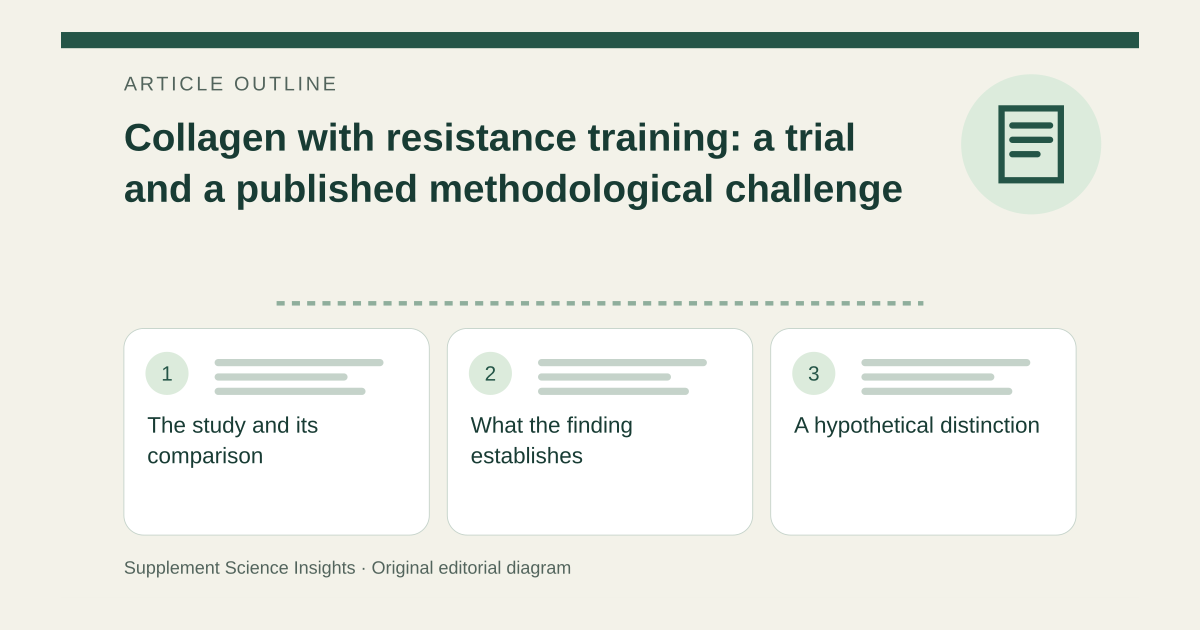
The study and its comparison
Fifty-three older men completed 12 weeks of resistance training with either 15 grams daily of collagen peptides or a silica placebo. Both groups improved; the collagen group showed larger changes in fat-free mass and strength. [1][2]
The 2016 letter questioned the magnitude of the changes and whether whole-body fat-free mass represented skeletal muscle. It also challenged the proposed amino-acid and creatine mechanisms. [1][2]
What the finding establishes
The letter is criticism, not a retraction or a replication. The trial lacked a comparison with another protein. GELITA partly supported it, and its authors declared no conflicts. Several letter authors disclosed dairy, meat, nutrition-company or consulting relationships. Neither side’s statement substitutes for independent confirmation. [1][2]
A hypothetical distinction
Imagine fat-free mass rises. That measure includes more than skeletal muscle, so its label should not be silently changed.
| Detail | Interpretation |
|---|---|
| Measured outcome | Keep the endpoint specific |
| Study preparation | Not every retail product |
| Remaining uncertainty | Not resolved by a mechanism |
Sources for this article
- Collagen peptide supplementation in combination with resistance training improves body composition and increases muscle strength in elderly sarcopenic men: a randomised controlled trial - PMC
Source consulted: 2026-09-19. This is a reference resource, not a claim that we conducted the studies or tested a product. - Exceptional body composition changes attributed to collagen peptide supplementation and resistance training in older sarcopenic men | British Journal of Nutrition | Cambridge Core
Source consulted: 2026-09-19. This is a reference resource, not a claim that we conducted the studies or tested a product.