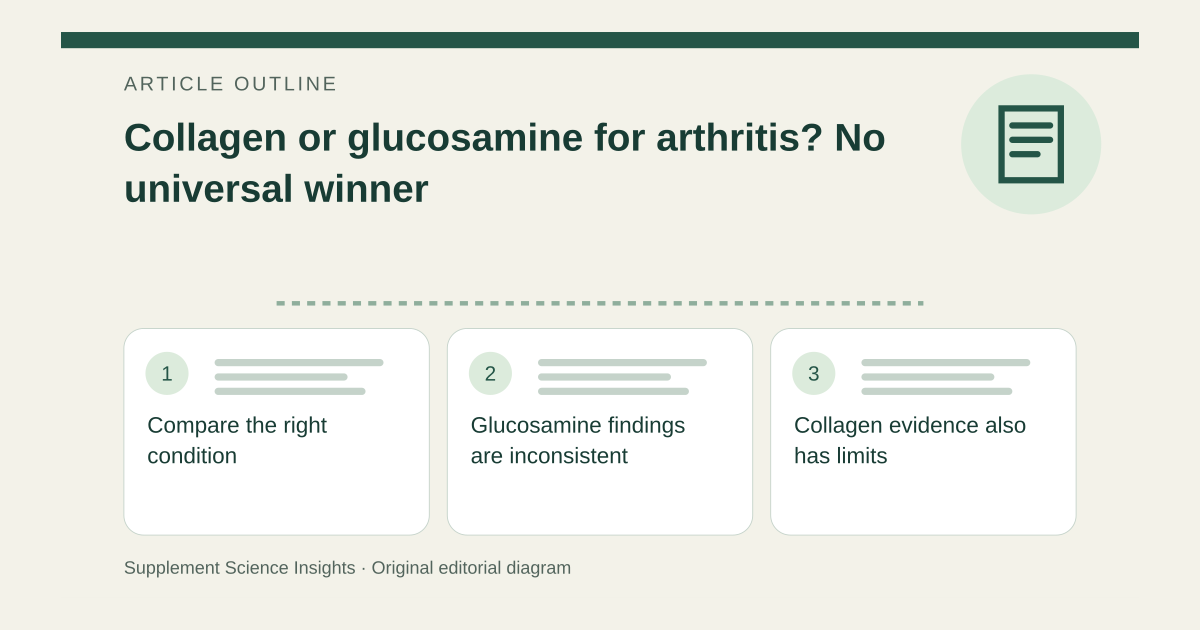
Compare the right condition
Most of the relevant supplement research concerns osteoarthritis symptoms. That is not the same as autoimmune arthritis or an acute injury. A change in pain or function should also not be rewritten as proof that a product rebuilds cartilage. [1][2]
Glucosamine findings are inconsistent
NCCIH describes conflicting study results and differing professional recommendations. Some guidelines recommend against glucosamine for knee osteoarthritis, while others distinguish particular prescription preparations or acknowledge possible benefits with inconsistent evidence. A generic retail product cannot automatically inherit a result for a specific formulation. [1]
Collagen evidence also has limits
MSK describes favorable osteoarthritis pain and function signals but rates the evidence as low quality. Hydrolyzed collagen and undenatured type II collagen are different preparations, so their milligram amounts and proposed mechanisms should not be treated as equivalent. These limits prevent a confident class-wide claim that collagen beats glucosamine. [2][3]
Safety may decide the practical choice
NCCIH warns about glucosamine/chondroitin and increased bleeding risk with warfarin, possible glucose effects and limited pregnancy or lactation safety information. Collagen products have source and added-ingredient considerations. Review the complete product with medicines and allergies rather than comparing benefits alone. [1][4][5]
Keep exercise and appropriate care central
NHS osteoarthritis care emphasizes tailored exercise, weight management when relevant and suitable symptom treatment. Imagine the goal is easier walking: track that activity within the treatment plan rather than switching supplements repeatedly without a defined outcome. Neither option should replace needed clinical care. [6]
| Question | Why it matters |
|---|---|
| Which diagnosis? | Evidence is condition-specific |
| Which formulation? | Not all products are interchangeable |
| Which outcome? | Pain relief is not cartilage restoration |
| Which medicines? | Safety can change the choice |
Sources for this article
- Glucosamine and Chondroitin for Osteoarthritis | NCCIH
Source consulted: 2026-09-21. This is a reference resource, not a claim that we conducted the studies or tested a product. - Collagen | Memorial Sloan Kettering Cancer Center
Source consulted: 2026-09-21. This is a reference resource, not a claim that we conducted the studies or tested a product. - Collagen Supplementation for Joint Health: The Link between Composition and Scientific Knowledge - PMC
Source consulted: 2026-09-21. This is a reference resource, not a claim that we conducted the studies or tested a product. - Food Allergies: What You Need to Know | FDA
Source consulted: 2026-09-21. This is a reference resource, not a claim that we conducted the studies or tested a product. - Dietary Supplements: What You Need to Know
Source consulted: 2026-09-21. This is a reference resource, not a claim that we conducted the studies or tested a product. - Osteoarthritis - Treatment and support - NHS
Source consulted: 2026-09-21. This is a reference resource, not a claim that we conducted the studies or tested a product.