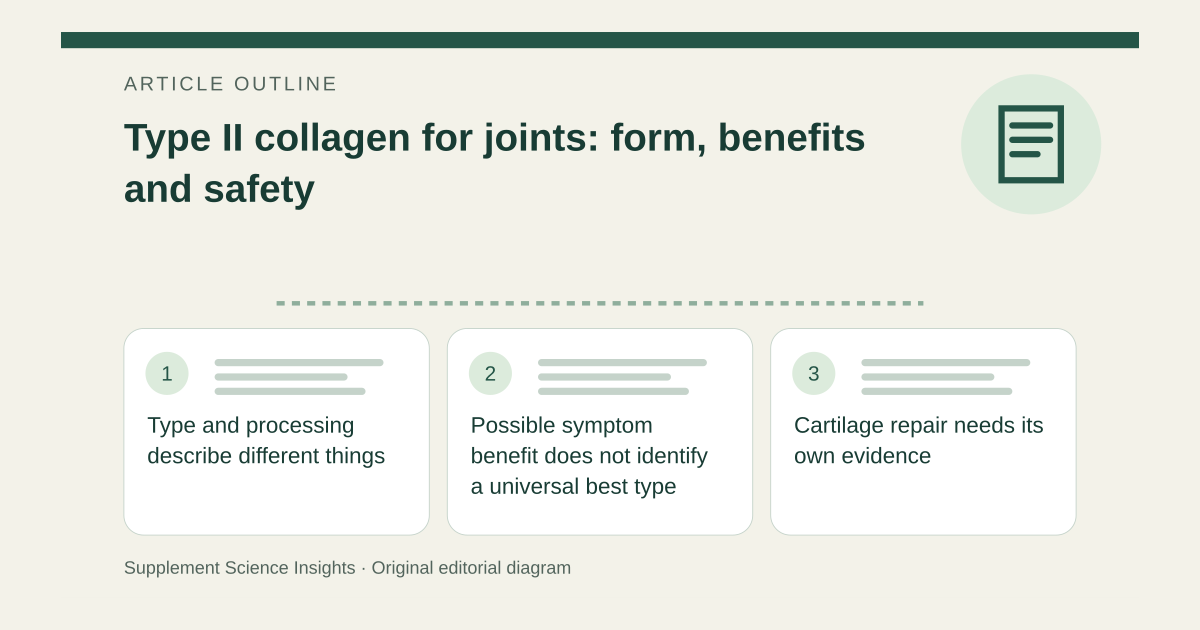
Type and processing describe different things
Type II names a collagen type. Undenatured material retains its native structure, whereas hydrolysis breaks collagen into smaller peptides. The Arthritis Foundation describes undenatured type II products commonly derived from chicken cartilage and hydrolyzed products from several animal sources. Read both source and processing rather than comparing only the Roman numeral. [1][2]
Possible symptom benefit does not identify a universal best type
MSK describes positive osteoarthritis pain and function findings but rates the evidence quality as low. This does not establish that every type II product outperforms every peptide powder. The industry-associated forms review is useful for terminology, not independent proof that its manufacturer’s preparation is best. [3][2]
Cartilage repair needs its own evidence
Less knee pain or improved function does not alone demonstrate new cartilage formation or reversal of osteoarthritis. A proposed biological mechanism is also not a structural outcome. Do not transfer an osteoarthritis result to rheumatoid arthritis or all inflammatory joint disease; the Arthritis Foundation describes unclear evidence for RA. [1][3]
Amounts and safety depend on the product
Undenatured and hydrolyzed preparations cannot be compared gram for gram as though they were the same intervention. Check the animal source, allergens, additional ingredients and directions. Food origin does not make every supplement harmless, and limited side-effect reporting does not establish safety for everyone. [2][4][5]
Choose care for the joint problem, not only a label
Imagine a person selects the largest collagen dose for a newly swollen knee. Neither the size nor the type establishes the diagnosis or replaces assessment. Consider any supplement alongside the joint-care plan and use a defined symptom goal rather than a cartilage-regrowth promise. [6][5]
| Label detail | Why it matters |
|---|---|
| Type II | Collagen identity |
| Undenatured or hydrolyzed | Different preparations |
| Pain outcome | Not the same as cartilage repair |
Sources for this article
- Are Collagen Supplements Helpful for Arthritis? | Arthritis Foundation
Source consulted: 2026-09-21. This is a reference resource, not a claim that we conducted the studies or tested a product. - Collagen Supplementation for Joint Health: The Link between Composition and Scientific Knowledge - PMC
Source consulted: 2026-09-21. This is a reference resource, not a claim that we conducted the studies or tested a product. - Collagen | Memorial Sloan Kettering Cancer Center
Source consulted: 2026-09-21. This is a reference resource, not a claim that we conducted the studies or tested a product. - Food Allergies: What You Need to Know | FDA
Source consulted: 2026-09-21. This is a reference resource, not a claim that we conducted the studies or tested a product. - Dietary Supplements: What You Need to Know
Source consulted: 2026-09-21. This is a reference resource, not a claim that we conducted the studies or tested a product. - Joint pain - NHS
Source consulted: 2026-09-21. This is a reference resource, not a claim that we conducted the studies or tested a product.